
Zofaril Co Tablet
PDF Leaflet Revision Date: 14 February 2023
Clinical Summary
Quick overview from the medicine insert
Indication
Treatment of mild to moderate essential hypertension.
Dosage (summary)
One tablet once daily for adults; not recommended for patients with volume or salt depletion.
Onset of Action / Duration
Onset: 2 hours, Duration: 6-12 hours
Special Populations
- Elderly patients
- Renal impairment
- Hepatic impairment
Pregnancy & Breastfeeding
Contraindicated in pregnancy and breastfeeding.
Key Drug Interactions
- Concomitant use with sacubitril/valsartan contraindicated
- Increased risk of angioedema with racecadotril and mTOR inhibitors
- Potassium-sparing diuretics may increase hyperkalaemia risk
Contraindications
- Hypersensitivity to zofenopril or hydrochlorothiazide
- History of angioedema with ACE inhibitors
- Severe renal impairment (CrCl < 30 mL/min)
- Severe hepatic impairment
Common side effects
- Dizziness
- Cough
- Hypotension
- Hyperkalaemia
Counselling Points
- Take once daily, with or without food
- Report any signs of infection or angioedema
- Avoid potassium supplements unless advised
Serious warnings
- Risk of severe hypotension after first dose
- Angioedema may occur
- Monitor renal function closely
Important Disclaimer
The Zofaril Co Tablet professional information leaflet below is the property of Lebasi Pharmaceuticals and is provided on Medinsert exactly as issued, with no.. alterations or editorial changes. We make every effort to keep content current by updating documents as soon as new versions become available. Medinsert serves as a trusted access point for healthcare professionals, but does not replace official sources or clinical judgement. For more details, please read our full disclaimer. read more>>
 Healthcare Professionals Only
This content is for registered healthcare professionals
Sign in or create a free account to read the full package insert.
Free for HPCSA-registered professionals. Powered by Medinsert.
Clinical Particulars
Section 4 of the official insert — extracted exactly as issued, no alterations
4.1 Therapeutic indications
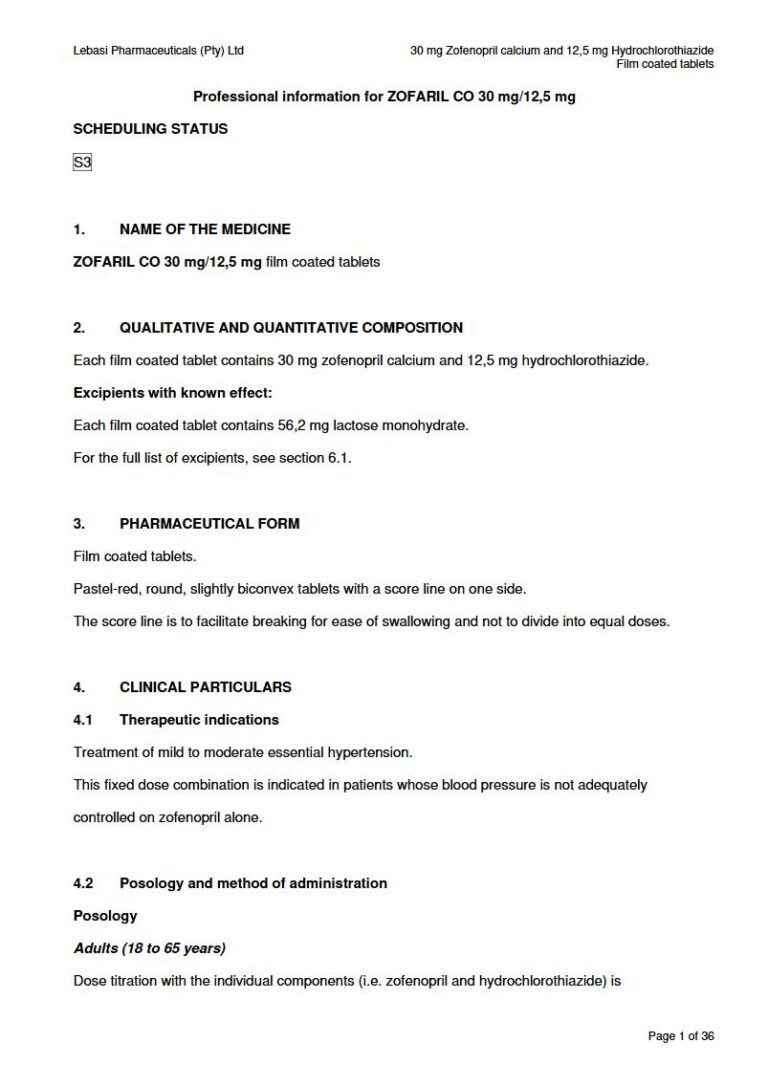
Treatment of mild to moderate essential hypertension. This fixed dose combination is indicated in patients whose blood pressure is not adequately controlled on zofenopril alone.
4.2 Posology and method of administration
Posology
Adults (18 to 65 years)
Dose titration with the individual components (i.e. zofenopril and hydrochlorothiazide) is recommended before changing to the fixed dose combination. When clinically appropriate direct change from monotherapy to the fixed combination may be considered.
Patients without volume or salt depletion
The usual effective dose is one tablet once daily.
Patients suspected to have volume or salt depletion
The use of ZOFARIL CO is not recommended.
Elderly patients (over 65 years)
In the elderly with normal creatinine clearance no dose adjustment is necessary. In the elderly with reduced creatinine clearance (less than 45 mL/min) the use of ZOFARIL CO is not recommended. Creatinine clearance may be estimated from serum creatinine by the following Cockroft-Gault formula: (140 - age) x mass (kg) x 0,85 (if female) CrCl (mL/min) = ________________________________ serum Cr (u03bcmol/L)
Paediatric population
ZOFARIL CO should not be given to children under the age of 18 years as safety and efficacy of ZOFARIL CO have not been established.
Patients with renal impairment and dialysis
In hypertensive patients with mild impairment (creatinine clearance > 45 mL/min) the same dose level and once-daily regimen of ZOFARIL CO can be employed as for patients with normal renal function. In patients with moderate to severe impairment (creatinine clearance < 45 mL/min) its use is not recommended (see section 4.4). In patients with severe renal impairment (creatinine clearance < 30 mL/min) ZOFARIL CO is contraindicated (see section 4.3). In hypertensive patients maintained on dialysis the use of ZOFARIL CO is not recommended.
Patients with hepatic impairment
In hypertensive patients with mild to moderate hepatic impairment (Child-Pugh A and B), where the 30 mg dose of zofenopril alone has been achieved, the same dose regimen can be employed as for patients with normal hepatic function. In hypertensive patients with severe liver impairment (Child-Pugh C) ZOFARIL CO is contraindicated.
Method of administration
ZOFARIL CO should be used once daily, with or without food. To ease swallowing, tablets may be broken in two parts and swallowed one half after the other, at the prescribed time of administration.
4.3 Contraindications
- Hypersensitivity to zofenopril or any other angiotensin-converting enzyme (ACE) inhibitor.
- Hypersensitivity to hydrochlorothiazide or other sulphonamide-derived substances.
- Hypersensitivity to any of the excipients (see section 6.1).
- History of angioedema associated with previous ACE inhibitors or angiotensin receptor blockers (ARBs): These patients must never again be given these medicines.
- Pregnancy and lactation (see sections 4.4 and 4.6).
- Concomitant use with sacubitril/valsartan therapy. ZOFARIL CO must not be initiated earlier than 36 hours after the last dose of sacubitril/valsartan (see sections 4.4 and 4.5).
- Hereditary/idiopathic angioedema.
- Hypertrophic obstructive cardiomyopathy (HOCM).
- Severe hepatic impairment.
- Severe renal impairment (creatinine clearance < 30 mL/min).
- Bilateral renal artery stenosis or unilateral renal artery stenosis in cases of a single kidney.
- Aortic stenosis.
- The concomitant use of ZOFARIL CO with aliskiren-containing products is contraindicated in patients with diabetes mellitus or renal impairment (GFR < 60 mL/min/1,73 m2) (see sections 4.5).
- Concomitant therapy with potassium sparing diuretics such as spironolactone, triamterene, amiloride (see section 4.5).
- Porphyria.
- Lithium therapy: Concomitant administration with ZOFARIL CO may lead to toxic blood concentrations of lithium (see section 4.5).
- Patients with a history of previous and/or current basal cell carcinomas and/or squamous cell carcinomas of the skin and lip.
- Concomitant use of fluoroquinolones with ZOFARIL CO is contraindicated in patients with moderate to severe renal impairment (creatinine clearance u2264 30 mL/min) and in elderly patients.
4.4 Special warnings and precautions for use
ZOFENOPRIL
Hypotension: As with other angiotensin-converting enzyme (ACE) inhibitors and diuretics, ZOFARIL CO may cause a profound fall in blood pressure especially after the first dose, although symptomatic hypotension is seen rarely in uncomplicated hypertensive patients. It is more likely to occur in patients who have been volume and electrolyte depleted by diuretic therapy, dietary salt restriction, dialysis, diarrhoea or vomiting, or who have severe renin-dependent hypertension (see section 4.5 and section 4.8).
In patients with heart failure, with or without associated renal insufficiency, symptomatic hypotension has been observed. This is more likely to occur in those patients with more severe degrees of heart failure, as reflected by the use of high doses of loop diuretics, hyponatraemia or functional renal impairment. In patients at increased risk of symptomatic hypotension, treatment should be started under close medical supervision preferably in the hospital, with low doses and careful dose titration. If possible, diuretic treatment should be discontinued temporarily when therapy with ZOFARIL CO is initiated. Such considerations apply also to patients with angina pectoris or cerebrovascular disease in whom an excessive fall in blood pressure could result in myocardial infarction or cerebrovascular incident. If hypotension develops, the patient should be placed in a supine position. Volume repletion with intravenous normal saline may be required. The appearance of hypotension after the initial dose does not preclude subsequent careful dose titration with medicine after effective management.
Patients with renovascular hypertension: There is an increased risk of severe hypotension and renal insufficiency when patients with bilateral renal artery stenosis or stenosis of the artery to a single functioning kidney are treated with ACE inhibitors, as in ZOFARIL CO. Treatment with diuretics may be a contributory factor. Loss of renal function may occur with only mild changes in serum creatinine even in patients with unilateral renal artery stenosis. In these patients, therapy should be initiated under close medical supervision with low dose, careful titration and monitoring of renal function.
Patients with renal insufficiency: Close monitoring of renal function during therapy should be performed as deemed appropriate. Renal failure has been reported in association with ZOFARIL CO, mainly in patients with severe heart failure or underlying renal disease, including renal artery stenosis. Some patients, with no apparent pre-existing renal disease have developed increases in blood urea and creatinine concentrations, particularly when a diuretic is given concomitantly. Dosage reduction of the individual components may be required. It is recommended that the renal function be monitored closely during the first few weeks of therapy.
Patients who are dialysed: Patients who are dialysed using high-flux polyacrylonitrile membranes (e.g. AN 69) and treated with ACE inhibitors, as in ZOFARIL CO are likely to experience anaphylactoid reactions such as facial swelling, flushing, hypotension and dyspnoea within a few minutes of commencing haemodialysis. It is recommended to use an alternative membrane or an alternative antihypertensive medicine. The efficacy and safety of zofenopril in myocardial infarction patients undergoing haemodialysis have not been established. Therefore, it should not be used in these patients.
Patients on LDL apheresis: Patients treated with an ACE inhibitor, as in ZOFARIL CO undergoing LDL apheresis with dextrane sulphate may experience anaphylactoid reactions similar to those seen in patients undergoing haemodialysis with high-flux membranes (see above). It is recommended that a medicine from another class of antihypertensive medicines is used in these patients.
Anaphylactic reactions during desensitisation or after insect bites/stings: Patients receiving ACE inhibitors, as in ZOFARIL CO during desensitisation treatment (e.g. hymenoptera venom) or after insect bites have experienced life-threatening anaphylactoid reactions. In the same patients, these reactions have been avoided when ACE inhibitors were temporarily withheld but they have reappeared upon inadvertent re-administration of the medicine. Therefore, caution should be used in patients treated with ZOFARIL CO undergoing such desensitisation procedures.
Kidney transplantation: There is no experience regarding the administration of ZOFARIL CO in patients with a recent kidney transplantation. Its use in transplant recipients is therefore not recommended.
Primary aldosteronism: Patients with primary aldosteronism generally will not respond to antihypertensive medicines acting through inhibition of the renin-angiotensin system. Therefore the use of ZOFARIL CO is not recommended.
Hypersensitivity/Angioedema: Angioedema of the face, extremities, lips, mucous membranes, tongue, glottis and/or larynx may occur in patients treated with ZOFARIL CO, which occurs most frequently during the first weeks of treatment. However, in rare cases severe angioedema may develop after long-term treatment with an angiotensin-converting enzyme inhibitor. Treatment with ZOFARIL CO should promptly be discontinued and replaced by an agent belonging to another class of antihypertensive medicines. Angioedema involving the tongue, glottis or larynx may be fatal. Emergency therapy should be given including, but not necessarily limited to, immediate subcutaneous epinephrine (adrenaline) solution 1:1 000 (0,3 to 0,5 mL) or slow intravenous epinephrine (adrenaline) 1 mg/mL (which should be diluted as instructed) with close monitoring of ECG and blood pressure. The patient should be hospitalised and observed for at least 12 to 24 hours and should not be discharged until complete resolution of symptoms has occurred. Even in such instances where swelling of only the tongue is involved, without respiratory distress, patients may require observation since treatment with antihistamines and corticosteroids may not be sufficient. Angiotensin-converting enzyme inhibitors cause a higher rate of angioedema in black patients than in non-black patients. Patients with a history of angioedema unrelated to ACE inhibitor therapy may be at increased risk of angioedema while receiving ZOFARIL CO (see section 4.3). Concomitant use of ZOFARIL CO with sacubitril/valsartan is contraindicated due to the increased risk of angioedema. Treatment with sacubitril/valsartan must not be initiated earlier than 36 hours after the last dose of ZOFARIL CO. Treatment with ZOFARIL CO must not be initiated earlier than 36 hours after the last dose of sacubitril/valsartan (see sections 4.3 and 4.5).
Cough: During treatment with ZOFARIL CO a dry and non-productive cough may occur which disappears after discontinuation of ZOFARIL CO. ACE inhibitor-induced cough should be considered as part of the differential diagnosis of cough.
Hepatic failure: ACE inhibitors, as in ZOFARIL CO have been associated with a syndrome that starts with cholestatic jaundice and progresses to fulminant hepatic necrosis and (sometimes) death. The mechanism of this syndrome is not understood. Patients receiving ZOFARIL CO who develop jaundice or marked elevations of hepatic enzymes should discontinue ZOFARIL CO and receive appropriate medical follow-up.
Serum potassium: ACE inhibitors, as in ZOFARIL CO can cause hyperkalaemia because they inhibit the release of aldosterone. The effect is usually not significant in patients with normal renal function. However, in patients with impaired renal function and/or in patients taking potassium supplements (including salt substitutes), potassium-sparing diuretics, heparin, trimethoprim or co-trimoxazole also known as trimethoprim/sulfamethoxazole and especially aldosterone antagonists or angiotensin receptor blockers, hyperkalaemia can occur. Potassium-sparing diuretics and angiotensin-receptor blockers should be used with caution in patients receiving ZOFARIL CO, and serum potassium and renal function should be monitored (see section 4.5).
Dual blockade of the renin-angiotensin-aldosterone system (RAAS): There is evidence that the concomitant use of ACE inhibitors (like ZOFARIL CO), angiotensin II receptor blockers or aliskiren increases the risk of hypotension, hyperkalaemia and decreased renal function (including acute renal failure). Dual blockade of RAAS through the combined use of ACE inhibitors (like ZOFARIL CO), angiotensin II receptor blockers or aliskiren is therefore not recommended (see sections 4.5). If dual blockade therapy is considered absolutely necessary, this should only occur under specialist supervision and subject to frequent close monitoring of renal function, electrolytes and blood pressure. ZOFARIL CO and angiotensin II receptor blockers should not be used concomitantly in patients with diabetic nephropathy.
Surgery/anaesthesia: ZOFARIL CO may cause hypotension or even hypotensive shock in patients undergoing major surgery or during anaesthesia, since they may block angiotensin II formation secondary to compensatory renin release. If it is not possible to withhold ZOFARIL CO, intravascular and plasma volumes should be carefully monitored.
Aortic and mitral valve stenosis/hypertrophic cardiomyopathy: ZOFARIL CO should be used with caution in patients with mitral valve stenosis and left ventricular outflow tract obstruction and avoided in cases of cardiogenic shock and haemodynamically significant obstruction.
Neutropenia/agranulocytosis: Neutropenia/agranulocytosis, thrombocytopenia and anaemia have been reported in patients receiving ZOFARIL CO. The risk of neutropenia appears to be dose- and type-related and is dependent on the patient's clinical status. It is rarely seen in uncomplicated patients but may occur in patients with some degree of renal impairment, especially when it is associated with collagen vascular disease e.g. systemic lupus erythematosus, scleroderma and therapy with immunosuppressive medicines, treatment with allopurinol or procainamide or a combination of these complicating factors. Some of these patients developed serious infections which in a few instances did not respond to intensive antibiotic therapy. If ZOFARIL CO is used in such patients, it is advised that white blood cell count and differential counts should be performed prior to therapy, every 2 weeks during the first 3 months of ZOFARIL CO therapy, and periodically thereafter. During treatment all patients should be instructed to report any sign of infection (e.g. sore throat, fever) when a differential white blood cell count should be performed. ZOFARIL CO and other concomitant medication (see section 4.5) should be withdrawn if neutropenia (neutrophils less than 1 000/mm3) is detected or suspected. It is reversible after discontinuation of ZOFARIL CO.
Psoriasis: ZOFARIL CO should be used with caution in patients with psoriasis.
Proteinuria: Proteinuria may occur particularly in patients with existing renal function impairment or on relatively high doses of ZOFARIL CO. Patients with prior renal disease should have urinary protein estimation (dip-stick on first morning urine) prior to treatment, and periodically thereafter.
Diabetic patients: The glycaemia levels should be closely monitored in diabetic patients previously treated with oral antidiabetic medicines or insulin, during the first month of treatment with ZOFARIL CO (see section 4.5).
Lithium: The combination of lithium and ZOFARIL CO is generally not recommended (see section 4.5).
Fluoroquinolones: Concomitant use of fluoroquinolones and ZOFARIL CO may precipitate acute kidney injury in patients, especially those with moderate to severe renal impairment and elderly patients (see section 4.3). Renal function should be assessed before initiating treatment and monitored during treatment with fluoroquinolones or ZOFARIL CO whether used separately and/or concomitantly.
Ethnic differences: ZOFARIL CO may be less effective in lowering blood pressure in black people than in non-blacks. Angiotensin-converting enzyme inhibitors cause a higher rate of angioedema in black patients than in non-black patients.
4.6 Fertility, pregnancy and lactation
Pregnancy
ZOFARIL CO should not be used in pregnancy. Women of childbearing age should ensure effective contraception if on ZOFARIL CO treatment. The use of ZOFARIL CO is not recommended during the first trimester of pregnancy (see section 4.4). The use of ZOFARIL CO is contraindicated during the second and third trimester of pregnancy (see sections 4.3 and 4.4). Patients planning pregnancy should be changed to alternative antihypertensive treatments which have an established safety profile for use in pregnancy. When pregnancy is diagnosed, treatment with ZOFARIL CO should be stopped immediately, and, if appropriate, alternative therapy should be started.
Breastfeeding
ZOFARIL CO should not be used while breastfeeding.
4.7 Effects on ability to drive and use machines
No studies on the effects on the ability to drive a vehicle and use machines have been performed. When driving vehicles or operating machines it should be remembered that occasionally drowsiness, dizziness or tiredness may occur.
4.8 Undesirable effects
In controlled clinical trials involving 597 patients randomised to receive ZOFARIL CO, no adverse reactions peculiar to this combination product have been observed. Adverse reactions have been limited to those that were reported previously with zofenopril calcium or hydrochlorothiazide. The incidence of undesirable effects showed no correlation with gender or age of the patients.
The table below shows all the adverse reactions that have been reported during clinical trials as at least probably-possibly related to treatment with ZOFARIL CO. They are listed by body-system and ranked under headings of frequency using the following convention: very common ( u2265 1/10); common ( u2265 1/100, < 1/10); uncommon ( u2265 1/1 000, u2264 1/100); rare ( u2265 1/10 000, u2264 1/1 000); very rare (u2264 1/10 000).
Infections and infestations
- Uncommon: infection, bronchitis, pharyngitis
Metabolism and nutrition disorders
- Uncommon: hypercholesterolaemia, hyperglycaemia, hyperlipidaemia, hypokalaemia, hyperkalaemia, hyperuricaemia
Psychiatric disorders
- Uncommon: insomnia
Nervous system disorders
- Common: dizziness, headache
- Uncommon: somnolence, syncope, hypertonia
Cardiac disorders
- Uncommon: angina pectoris, atrial fibrillation, myocardial infarction, palpitations
Vascular disorders
- Uncommon: flushing, hypotension, hypertension
Respiratory, thoracic and mediastinal disorders
- Common: cough
- Uncommon: dyspnoea
Gastrointestinal disorders
- Uncommon: nausea, dyspepsia, gastritis, gingivitis, dry mouth, abdominal pain
Skin and subcutaneous tissue disorders
- Uncommon: angioedema, psoriasis, acne, dry skin, pruritus, urticaria
Musculoskeletal and connective tissue disorders
- Uncommon: back pain
Renal and urinary disorders
- Uncommon: polyuria
Reproductive system and breast disorders
- Uncommon: erectile dysfunction
General disorders and administration site conditions
- Uncommon: asthenia, influenza-like illness, peripheral oedema
Investigations
- Uncommon: creatinine increase, abnormal liver function test
Additional information on individual component: Adverse reactions known to occur with each component given as monotherapy may occur during treatment with ZOFARIL CO:
ZOFENOPRIL
The most common undesirable effects typical of ACE inhibitors that occurred in clinical trials in patients treated with zofenopril were the following:
Nervous system disorders
- Common: dizziness, headache
Respiratory, thoracic and mediastinal disorders
- Common: cough
Gastrointestinal disorders
- Common: nausea/vomiting
Skin and subcutaneous tissue disorders
- Uncommon: rash
Rare: angioedema
Musculoskeletal and connective tissue disorders
- Uncommon: muscle spasms
General disorders and administration site conditions
- Common: fatigue
- Uncommon: asthenia
The following adverse reactions have been observed associated with ACE inhibitor therapy:
Blood and lymphatic system disorders
- In a few patients, agranulocytosis and pancytopenia may occur.
There were reports of haemolytic anaemia in patients with glucose 6-phosphate dehydrogenase deficiency.
Endocrine disorders
- Not known, inappropriate antidiuretic hormone secretion.
Metabolism and nutrition disorders
- Very rare, hypoglycaemia.
Psychiatric disorders
- Rarely, depression, altered mood, sleep disorders, confusional state.
Nervous system disorders
- Occasionally paraesthesia, dysgeusia, balance disorder.
Eye disorders
- Rarely, blurred vision.
Ear and labyrinth disorders
- Rarely, tinnitus.
Cardiac disorders
- Individual cases of tachycardia, palpitations, dysrhythmias, angina pectoris, and myocardial infarction have been reported for ACE inhibitors in association with hypotension.
Vascular disorders
- Severe hypotension has occurred after initiation or increase of therapy. This occurs especially in certain risk groups (see section 4.4). In association with hypotension, symptoms like dizziness, feeling of weakness, impaired vision, rarely with disturbance of consciousness (syncope) have been reported.
Rarely, flushing.
Respiratory, thoracic and mediastinal disorders
- Rarely, dyspnoea, sinusitis, rhinitis, glossitis, bronchitis and bronchospasm have been reported. ACE inhibitors have been associated with the onset of angioneurotic oedema in a small subset of patients, involving the face and oropharyngeal tissues. In isolated cases angioneurotic oedema involving the upper airways has caused fatal airway obstruction.
Gastrointestinal disorders
- Occasionally, abdominal pain, diarrhoea, constipation and dry mouth can occur. Individual cases of pancreatitis and ileus have been described in association with ACE inhibitors.
Very rare, small bowel angioedema.
Hepato-biliary disorders
- Individual cases of cholestatic jaundice and hepatitis have been described in association with ACE inhibitors.
Skin and subcutaneous tissue disorders
- Occasionally allergic and hypersensitivity reactions can occur like pruritus, urticaria, erythema multiforme, Stevens-Johnson syndrome, toxic epidermal necrolysis, psoriasis-like efflorescences, alopecia. This can be accompanied by fever, myalgia, arthralgia, eosinophilia and/or increased ANA-titres.
Rarely, hyperhidrosis.
Musculoskeletal and connective tissue disorders
- Occasionally, myalgia can occur.
Renal and urinary disorders
- Renal insufficiency may occur or be intensified. Acute renal failure has been reported (see section 4.4).
Rarely, micturition disorders.
Reproductive system and breast disorders
- Rarely, erectile dysfunction.
General disorders and administration site conditions
- Very rare, peripheral oedema and chest pain.
Investigations
- Increases in blood urea and creatinine, reversible on discontinuation may occur, especially in the presence of renal insufficiency, severe heart failure and renovascular hypertension. In a few patients, decreases in haemoglobin, haematocrit, platelets and white cell count have been reported. Increases in serum levels of hepatic enzymes and bilirubin have also been reported.
4.9 Overdose
Symptoms of overdosage are severe hypotension, shock, stupor, bradycardia, electrolyte disturbances and renal failure. Treatment is symptomatic and supportive. After ingestion of an overdose, the patient should be kept under close supervision, preferably in an intensive care unit. Serum electrolytes and creatinine should be monitored frequently. Therapeutic measures depend on the nature and severity of the symptoms. If the ingestion is recent, measures to prevent absorption such as administration of adsorbents and sodium sulphate may be implemented. If hypotension occurs, the patient should be placed in shock position and the judicious use of volume expanders and/or treatment with angiotensin II should be considered. Bradycardia or extensive vagal reactions should be treated by administering atropine. The use of a pacemaker may be considered. ACE inhibitors may be removed from the circulation by haemodialysis. The use of high-flux polyacrylonitrile membranes should be avoided. Overdosage with hydrochlorothiazide is associated with electrolyte depletion (hypokalaemia, hypochloraemia) and dehydration resulting from excessive diuresis. The most common signs and symptoms of overdosage are nausea and somnolence. Hypokalaemia may result in muscle spasm and/or accentuate cardiac dysrhythmias associated with the concomitant use of digitalis glycosides or certain antidysrhythmic medicines.
