
Spersallergâ 0.5 mg /1 ml. Sterile eye drops
PDF Leaflet Revision Date: 21/02/2022
Clinical Summary
Quick overview from the medicine insert
Indication
For hay-fever and allergic conjunctivitis.
Dosage (summary)
1 drop, 3-4 times daily for adults; 1 drop once or twice daily for children 2-12 years.
Special Populations
- Children under 2 years
- Patients with narrow angle glaucoma
- Patients with hypertension
Pregnancy & Breastfeeding
Safety in pregnancy and lactation not established.
Key Drug Interactions
- MAO inhibitors
- Tricyclic antidepressants
Contraindications
- Hypersensitivity to ingredients
- Dry eyes
- Narrow angle glaucoma
Common side effects
- Headaches
- Drowsiness
- Transient irritation
- Blurred vision
Counselling Points
- Do not wear soft contact lenses during use.
- Consult doctor if symptoms persist after 3 days.
- Avoid driving if vision is blurred.
Serious warnings
- CNS depression in children
- Risk of rebound congestion
- Use with caution in hypertension
Important Disclaimer
The Spersallergâ 0.5 mg /1 ml. Sterile eye drops professional information leaflet below is the property of Adcock Ingram and is provided on Medinsert exactly as issued, with no.. alterations or editorial changes. We make every effort to keep content current by updating documents as soon as new versions become available. Medinsert serves as a trusted access point for healthcare professionals, but does not replace official sources or clinical judgement. For more details, please read our full disclaimer. read more>>
 Healthcare Professionals Only
This content is for registered healthcare professionals
Sign in or create a free account to read the full package insert.
Free for HPCSA-registered professionals. Powered by Medinsert.
Clinical Particulars
Section 4 of the official insert — extracted exactly as issued, no alterations
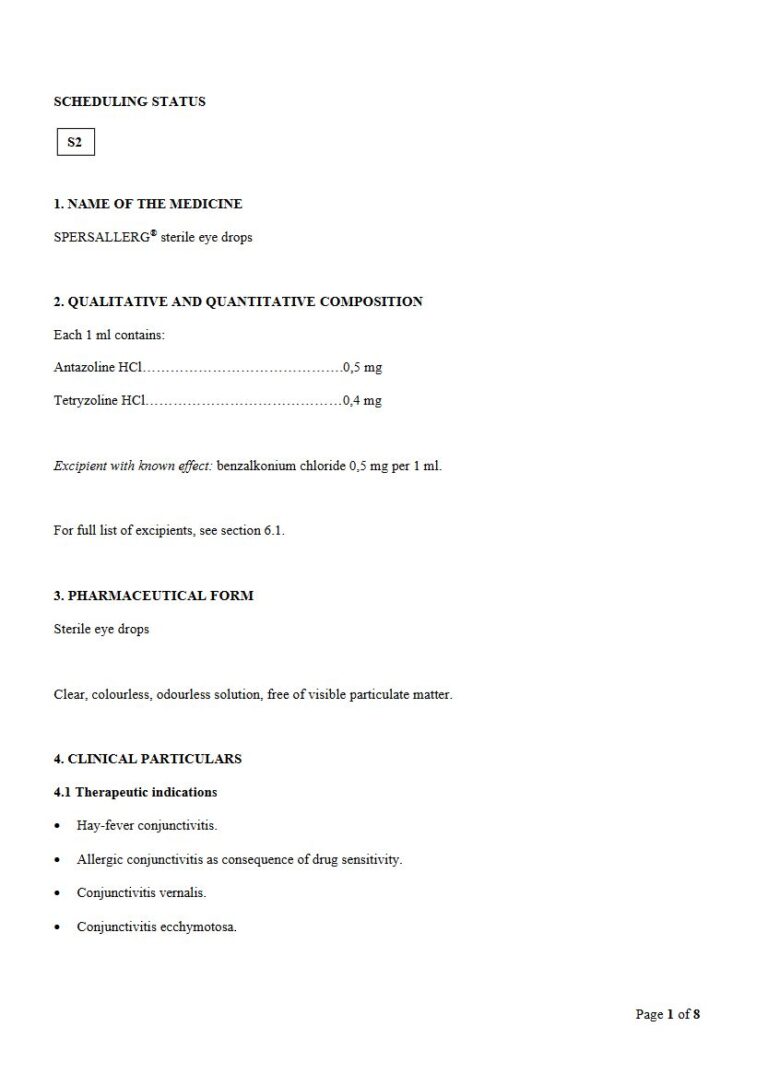
4.1 Therapeutic indications
- Hay-fever conjunctivitis.
- Allergic conjunctivitis as consequence of drug sensitivity.
- Conjunctivitis vernalis.
- Conjunctivitis ecchymotosa.
4.2 Posology and method of administration
Adult
Instill 1 drop, 3 or 4 times daily, into the lower eyelid.
Children 2 u2013 12 years
Instill 1 drop daily or twice daily. Not recommended for children under the age of 2 years. If redness or irritation continues, gets worse or lasts for more than 3 days consult your doctor.
4.3 Contraindications
- Hypersensitivity to antazoline HCl, tetryzoline HCl or to any of the excipients of SPERSALLERG u00ae (see section 6.1).
- Patients with dry eyes, especially keratoconjunctivitis sicca
- Patients at a risk of narrow angle glaucoma.
- Patients receiving monoamine oxidase inhibitors or within 14 days of its treatment.
- Not recommended for children under two years of age, due to the greater incidence of systemic absorption and effects.
4.4 Special warnings and precautions for use
Soft contact lenses should not be worn during instillation of SPERSALLERG u00ae. They can be reinserted after an interval of at least 5 minutes. Tetryzoline should be given with care in cases of high hypertension or hyperglycaemia (diabetes), also in children under 2 years. Use with caution in patients with increased intra-ocular pressure, hypertension, cardiac irregularities including heart failure, in patients with poorly controlled hypertension and diabetes mellitus, hyperthyroidism or pheochromocytoma and eye infections.
4.5 Interaction with other medicines and other forms of interaction
No synergic effect can occur due to the low dose. In cases where another ophthalmic treatment is used, allow an interval of 5 minutes between each administration so as not to wash away the active ingredient. Preparations containing tetryzoline may not be used in patients receiving MAO inhibitors until ten days after the last treatment with such active ingredients (increase in blood pressure resulting from the concomitant use of MAO inhibitors and tricyclic antidepressants).
4.6 Fertility, pregnancy and lactation
Safety in pregnancy and lactation has not been established. No controlled studies are available either in animals, pregnant or nursing women. It is not known whether either active substance of SPERSALLERG u00ae passes into breast milk.
4.7 Effects on ability to drive and use machines
Patients with visual disturbances such as blurred vision after application of the SPERSALLERG u00ae should not drive vehicles or use machines until their vision is restored.
4.8 Undesirable effects
Tabulated list of adverse reactions
MedDRA System Organ Class Frequency Frequency unknown
Immune system disorders Unknown frequency Hypersensitivity reactions may occur
Nervous system disorders Rare Headaches, drowsiness, tremor, agitation
Eye disorders Rare Transient irritation may occur immediately after instillation, blurred vision (after systemic absorption), mydriasis, elevation of intraocular pressure, systemic undesirable effects due to absorption, reactive hyperaemia (after discontinuation of the treatment)
Cardiac disorders Rare Tachycardia (particularly in small children), pectanginous symptoms
Vascular disorders Rare Hypertension
Skin and subcutaneous tissue disorders Rare Perspiration
4.9 Overdose
Symptoms
After accidental ingestion, especially in children, overdosage is associated with antimuscarinic, extrapyramidal and CNS stimulation and depression. CNS stimulation causes ataxia, excitement, tremors, psychoses, hallucinations, convulsions, hyperexia may also occur. Deepening coma and cardiorespiratory collapse may follow. CNS depression causes drowsiness, coma, convulsions, progressing to respiratory failure or possible cardiovascular collapse.
Treatment
Treatment is symptomatic and supportive, including artificial respiration if necessary. If patient is conscious and has not lost the gag reflex and not having seizures, emesis should be induced. If emesis cannot be induced, gastric lavage is indicated.
