
Spersatear. 3 mg Eye drops. solution.
PDF Leaflet Revision Date: 01 March 2022
Clinical Summary
Quick overview from the medicine insert
Indication
Artificial tear for dry eye conditions.
Dosage (summary)
Two drops three times a day into each eye or as required.
Pregnancy & Breastfeeding
Negligible systemic exposure; considered safe in pregnancy and breastfeeding.
Key Drug Interactions
- Prolongs contact time of other ophthalmic medicines.
Contraindications
- Hypersensitivity to hypromellose or excipients.
Common side effects
- Transient mild stinging
- Blurred vision
- Eye pain
- Eye irritation
Counselling Points
- Do not touch dropper tip to any surface.
- Remove contact lenses before use.
Serious warnings
- May cause blurred vision; do not drive or operate machinery until vision is clear.
Important Disclaimer
The Spersatear. 3 mg Eye drops. solution. professional information leaflet below is the property of Adcock Ingram and is provided on Medinsert exactly as issued, with no.. alterations or editorial changes. We make every effort to keep content current by updating documents as soon as new versions become available. Medinsert serves as a trusted access point for healthcare professionals, but does not replace official sources or clinical judgement. For more details, please read our full disclaimer. read more>>
 Healthcare Professionals Only
This content is for registered healthcare professionals
Sign in or create a free account to read the full package insert.
Free for HPCSA-registered professionals. Powered by Medinsert.
Clinical Particulars
Section 4 of the official insert — extracted exactly as issued, no alterations
4.1 Therapeutic indications
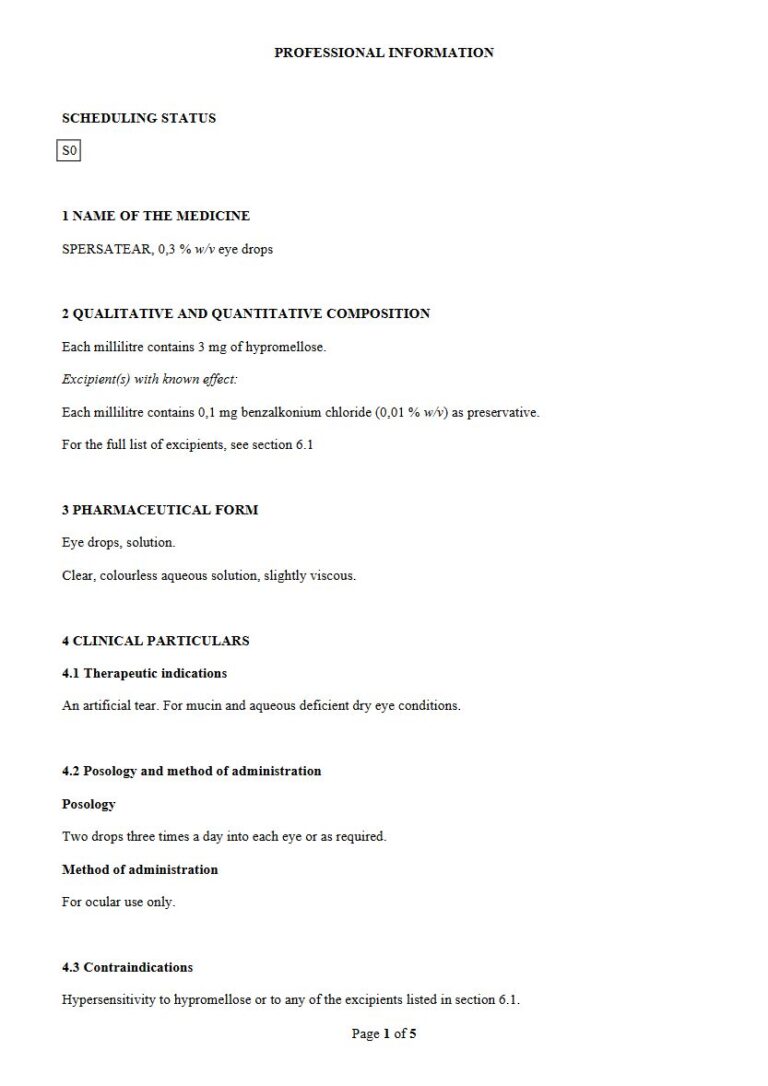
An artificial tear. For mucin and aqueous deficient dry eye conditions.
4.2 Posology and method of administration
Posology
Two drops three times a day into each eye or as required.
Method of administration
For ocular use only.
4.3 Contraindications
Hypersensitivity to hypromellose or to any of the excipients listed in section 6.1.
4.4 Special warnings and precautions for use
May cause transient mild stinging or temporary blurred vision. If irritation persists or worsens, or headache, eye pain, vision changes or continuous redness occur, patients should discontinue use and consult a doctor or pharmacist (see section 4.8). In order to preserve the sterility, the dropper should not be allowed to touch any part of the eye or any other surface. SPERSATEAR contains 0,1 mg/ml benzalkonium chloride as preservative which may be deposited in soft contact lenses. Hence, SPERSATEAR should not be used while wearing these lenses. The lenses should be removed before instillation of the drops and not reinserted earlier than 15 minutes after use. Benzalkonium chloride has been reported to cause eye irritation, symptoms of dry eyes and may affect the tear film and corneal surface. Should be used with caution in dry eye patients and in patients where the cornea may be compromised. Patients should be monitored in case of prolonged use. SPERSATEAR is not intended as a vehicle for other medicines.
4.5 Interaction with other medicines and other forms of interaction
Hypromellose prolongs the contact time of topically applied medicines commonly used in ophthalmology.
4.6 Fertility, pregnancy and lactation
Fertility
Studies have not been performed to evaluate the effect of topical ocular administration of hypromellose on fertility. Hypromellose is a pharmacologically inert compound, and it would not be expected to have any effect on fertility.
Pregnancy
There are no or limited amount of data from the use of ophthalmic hypromellose in pregnant women. Systemic exposure to hypromellose following topical ocular administration is negligible and the product has no pharmacological properties.
Breastfeeding
It is unknown whether topical hypromellose/metabolites are excreted in human milk. No effects on the breastfed newborn/infant are anticipated since the systemic exposure of the breastfeeding woman to hypromellose is negligible. In addition to this, hypromellose is pharmacologically inert.
4.7 Effects on ability to drive and use machines
May cause blurring of vision on instillation. Do not drive or operate hazardous machinery unless vision is clear.
4.8 Undesirable effects
System Organ Class Frequency Adverse event
Eye disorders Not known transient mild stinging or vision blurred, eye pain, foreign body sensation in eyes, eye irritation, ocular hyperaemia
Reporting of suspected adverse reactions
Reporting suspected adverse reactions after authorisation of the medicine is important. It allows continued monitoring of the benefit/risk balance of the medicine. Healthcare providers are asked to report any suspected adverse reactions to SAHPRA via the u201c6.04 Adverse Drug Reactions Reporting Formu201d, found online under SAHPRAu2019s publications: https://www.sahpra.org.za/Publications/Index/8.
4.9 Overdose
Due to the characteristics of this preparation, no toxic effects are to be expected with an ocular overdose of SPERSATEAR, nor in the event of accidental ingestion of the contents of one bottle.
