
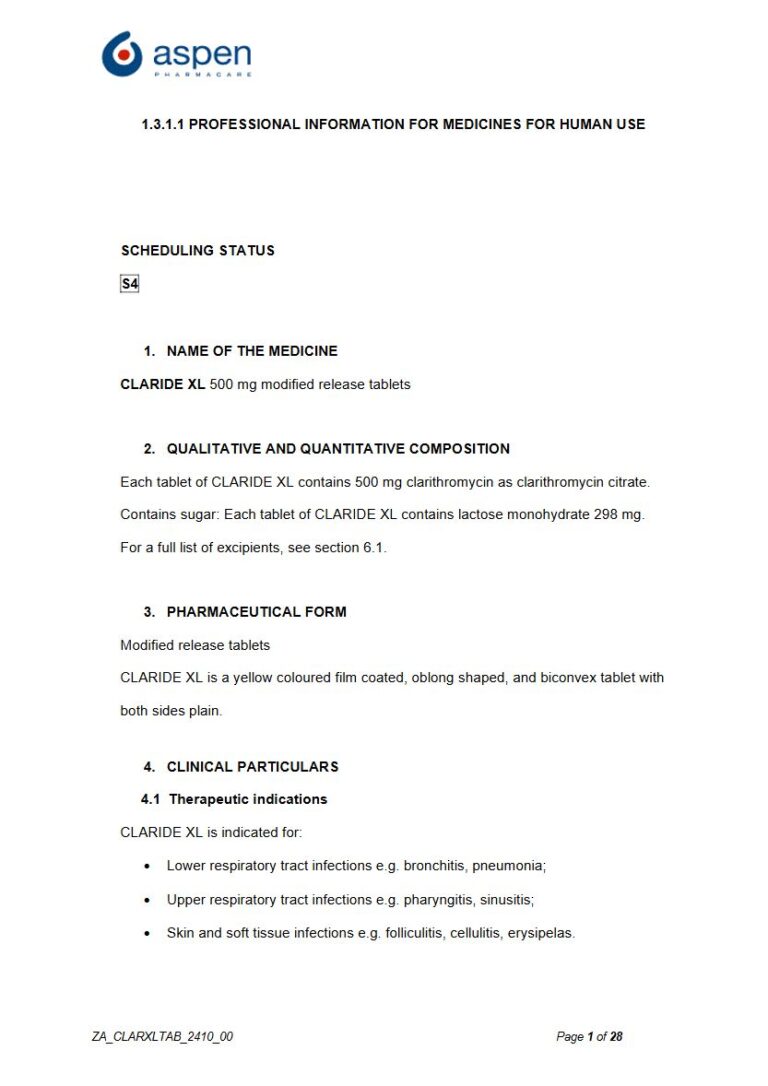
Claride Xl 500 mg MR tablets
PDF Leaflet Revision Date: 08 October 2024
Clinical Summary
Quick overview from the medicine insert
Indication
Indicated for respiratory and skin infections.
Dosage (summary)
500 mg once daily with food; may increase to 1000 mg for severe infections.
Special Populations
- Renal impairment
- Hepatic impairment
Pregnancy & Breastfeeding
Not established for pregnancy; excreted in breast milk.
Key Drug Interactions
- Warfarin
- Statins
- Colchicine
Contraindications
- Hypersensitivity to clarithromycin
- Severe renal impairment
- QT prolongation
- Severe hepatic failure
Common side effects
- Abdominal pain
- Nausea
- Vomiting
- Taste perversion
Counselling Points
- Take with food
- Monitor for signs of liver dysfunction
- Avoid in pregnancy
Serious warnings
- Risk of severe hypersensitivity reactions
- QT prolongation
- Hepatic failure
Important Disclaimer
The Claride Xl 500 mg MR tablets professional information leaflet below is the property of Aspen Pharmacare and is provided on Medinsert exactly as issued, with no.. alterations or editorial changes. We make every effort to keep content current by updating documents as soon as new versions become available. Medinsert serves as a trusted access point for healthcare professionals, but does not replace official sources or clinical judgement. For more details, please read our full disclaimer. read more>>
 Healthcare Professionals Only
This content is for registered healthcare professionals
Sign in or create a free account to read the full package insert.
Free for HPCSA-registered professionals. Powered by Medinsert.
Clinical Particulars
Section 4 of the official insert — extracted exactly as issued, no alterations
4.1 Therapeutic indications
CLARIDE XL is indicated for:
- Lower respiratory tract infections e.g. bronchitis, pneumonia;
- Upper respiratory tract infections e.g. pharyngitis, sinusitis;
- Skin and soft tissue infections e.g. folliculitis, cellulitis, erysipelas.
4.2 Posology and method of administration
Posology
Adults
The recommended dosage of CLARIDE XL in adults is 500 mg (one CLARIDE XL 500 mg tablet) once daily with food. In more severe infections, the dosage can be increased to 1 000 mg once daily (two CLARIDE XL 500 mg tablets).
Special populations
Renal impairment
CLARIDE XL tablets should not be used in patients with significant renal impairment (creatinine clearance less than 30 mL / min) as appropriate CLARIDE XL dosage reduction is not possible when administering this medicine. For patients with moderate renal function (creatinine clearance 30 to 60 mL / min), a 50 % dosage reduction should be implemented resulting in a maximum dose of one CLARIDE XL tablet per day (see section 4.3).
Paediatric population
CLARIDE XL is not suitable for children younger than 12 years.
Method of administration
For oral administration. CLARIDE XL tablets should be swallowed whole.
4.3 Contraindications
CLARIDE XL is contraindicated in:
- Patients with hypersensitivity to clarithromycin, macrolide antibiotic medicines or to any of the excipients in CLARIDE XL (see section 6.1);
- Patients with creatinine clearance less than 30 mL/min (see section 4.2; Renal impairment);
- Patients with a history of QT prolongation or ventricular cardiac dysrhythmia, including torsades de pointes (see sections 4.4 and 4.5);
- Patients who suffer from severe hepatic failure in combination with renal impairment.
- Patients with hypokalaemia (risk of prolongation of QT - time);
- Concomitant administration of CLARIDE XL and any of the following medicines is contraindicated: astemizole, cisapride, pimozide, terfenadine and ergotamine or dihydroergotamine (see section 4.5).
- Concomitant administration of CLARIDE XL and oral midazolam is contraindicated (see section 4.5).
- Concomitant administration with ticagrelor or ranolazine is contraindicated.
- Concomitant use with HMG-CoA reductase inhibitors (statins) that are extensively metabolized by CYP3A4, (lovastatin or simvastatin), due to the increased risk of myopathy, including rhabdomyolysis (see section 4.5);
- Colchicine is contraindicated in patients with renal or hepatic impairment who are taking P-glycoprotein or a strong CYP3A4 inhibitor.
4.4 Special warnings and precautions for use
Hypersensitivity
In the event of severe acute hypersensitivity reactions, such as anaphylaxis, Severe Cutaneous Adverse Reactions (SCAR) (e.g. Acute Generalised Exanthematous Pustulosis (AGEP), Stevens - Johnson Syndrome (SJS), Toxic Epidermal Necrolysis (TEN) and Drug Rash with Eosinophilia and Systemic Symptoms (DRESS), CLARIDE XL therapy should be discontinued immediately and appropriate treatment should be urgently initiated.
Cardiovascular disorders
There is an increased risk of death in patients with heart disease and health care providers should consider using other antibiotics in such patients.
Hepatic disorders
CLARIDE XL is principally metabolised by the liver. Therefore, caution should be exercised in administering this antibiotic to patients with impaired hepatic function. Caution should also be exercised when administering CLARIDE XL to patients with moderate to severe renal impairment (see section 4.3). Cases of fatal hepatic failure (see section 4.8) have been reported. Some patients may have had pre-existing hepatic disease or may have been taking other hepatotoxic medicinal products. Patients should be advised to stop treatment and contact their doctor if signs and symptoms of hepatic disease develop, such as anorexia, jaundice, dark urine, pruritus, or tender abdomen.
Clostridium difficile - associated diarrhoea (CDAD)
Pseudomembranous colitis has been reported with nearly all antibacterial medicines, including clarithromycin, and may range in severity from mild to life threatening. CDAD has been reported with use of nearly all antibacterial medicines including clarithromycin, and may range in severity from mild diarrhoea to fatal colitis. Treatment with antibacterial medicines alters the normal flora of the colon, which may lead to overgrowth of C. difficile. Therefore, it is important to consider this diagnosis in patients who present with diarrhoea subsequent to the administration of antibacterial medicines.
Prolonged or repeated use of clarithromycin may result in an overgrowth of non-susceptible bacteria or fungi. If super-infection occurs, clarithromycin should be discontinued and appropriate therapy instituted. Microbial testing should be performed and adequate treatment initiated. Medicines inhibiting peristalsis should be avoided.
Myasthenia gravis
Exacerbation of symptoms of myasthenia gravis has been reported in patients receiving clarithromycin therapy (see section 4.8).
Colchicine
Colchicine toxicity has been reported with the concomitant use of clarithromycin, as contained in CLARIDE XL, and colchicine, especially in the elderly, or in patients with renal insufficiency. Deaths have occurred. Concomitant administration of clarithromycin, as contained in CLARIDE XL, and colchicine is contraindicated (see sections 4.3 and 4.5).
Benzodiazepines
Caution is advised regarding concomitant administration of CLARIDE XL and triazolo benzodiazepines, such as triazolam, and intravenous or oromucosal midazolam (see sections 4.3 and 4.5).
Ototoxic medicines
Caution is advised regarding concomitant administration of clarithromycin with other ototoxic medicines, especially with aminoglycosides. Monitoring of vestibular and auditory function should be carried out during and after treatment.
Prolongation of the QT interval
Due to the risk for QT prolongation, clarithromycin should be used with caution in patients with coronary artery disease, severe cardiac insufficiency, hypomagnesaemia, bradycardia (< 50 bpm), or when co-administered with other medicinal products associated with QT prolongation (see section 4.5). Clarithromycin must not be used in patients with congenital or documented acquired QT prolongation or history of ventricular arrhythmia (see section 4.3).
Pneumonia
It is important that sensitivity testing be performed when prescribing CLARIDE XL for community-acquired pneumonia. In hospital-acquired pneumonia, CLARIDE XL should be used in combination with additional appropriate antibiotics.
Skin and soft tissue infections of mild to moderate severity
These infections are most often caused by Staphylococcus aureus and Streptococcus pyogenes, both of which may be resistant to macrolides. Therefore, it is important that sensitivity testing be performed. In cases where beta u2013lactam antibiotics cannot be used (e.g. allergy), other antibiotics, such as clindamycin, may be the medicine of first choice. Currently, macrolides are only considered to play a role in some skin and soft tissue infections, such as those caused by Corynebacterium minutissimum, acne vulgaris, and erysipelas and in situations where penicillin treatment cannot be used. CLARIDE XL should be used with caution when administered concurrently with medications that induce the cytochrome CYP3A4 enzyme (see section 4.5).
4.5 Interactions with other medicines
The use of the following medicines is strictly contraindicated due to the potential for severe medicine interaction effects:
- Cisapride, pimozide, astemizole and terfenadine
Elevated cisapride levels have been reported in patients receiving clarithromycin, as contained in CLARIDE XL, and cisapride concomitantly. This may result in QT prolongation and cardiac dysrhythmias including ventricular tachycardia, ventricular fibrillation and torsades de pointes. Similar effects have been reported in patients taking clarithromycin, as contained in CLARIDE XL, and pimozide concomitantly (see section 4.3).
Macrolides have been reported to alter the metabolism of terfenadine resulting in increased levels of terfenadine which has occasionally been associated with cardiac arrhythmias such as QT prolongation, ventricular tachycardia, ventricular fibrillation and torsades de pointes (see section 4.3). In one study in 14 healthy volunteers, the concomitant administration of clarithromycin and terfenadine resulted in a two to three fold increase in the serum level of the acid metabolite of terfenadine and in prolongation of the QT interval which did not lead to any clinically detectable effect. Similar effects have been observed with concomitant administration of astemizole and other macrolides.
Ergotamine/dihydroergotamine
Co-administration of clarithromycin with ergotamine or dihydroergotamine has been associated with acute ergot toxicity characterized by vasospasm, and ischemia of the extremities and other tissues including the central nervous system. Concomitant administration of clarithromycin and these medicinal products is contraindicated (see section 4.3).
HMG-CoA reductase inhibitors (statins)
Concomitant use of clarithromycin with lovastatin or simvastatin is contraindicated (see section 4.3 and section 4.4).
Effect of other medicinal products on clarithromycin
Products that are inducers of CYP3A4 (e.g. rifampicin, phenytoin, carbamazepine, phenobarbital, St. Johnu2019s wort) may induce the metabolism of clarithromycin. This may result in sub-therapeutic levels of clarithromycin leading to a reduced efficacy. Furthermore it might be necessary to monitor the plasma levels of the CYP3A4 inducer, which could be increased owing to the inhibition of CYP3A4 by clarithromycin (see also the relevant product information for the CYP3A4 inducer administered). Concomitant administration of rifabutin and clarithromycin resulted in an increase in rifabutin, and decrease in clarithromycin serum levels together with an increased risk of uveitis.
The following medicines are known or suspected to affect circulating concentrations of clarithromycin; clarithromycin dosage adjustment or consideration of alternative treatments may be required: Efavirenz, nevirapine, rifampicin, rifabutin and rifapentine. Strong inducers of the cytochrome P450 metabolism system such as efavirenz, nevirapine, rifampicin, rifabutin, and rifapentine may accelerate the metabolism of clarithromycin and thus lower the plasma levels of clarithromycin, while increasing those of 14-OH-clarithromycin, a metabolite that is also microbiologically active. Since the microbiological activities of clarithromycin and 14-OH-clarithromycin are different for different bacteria, the intended therapeutic effect could be impaired during concomitant administration of clarithromycin and enzyme inducers.
Etravirine
Clarithromycin, as contained in CLARIDE XL, exposure was decreased by etravirine; however, concentrations of the active metabolite, 14-OH-clarithromycin, were increased. Because 14-OH-clarithromycin has reduced activity against Mycobacterium avium complex (MAC), overall activity against this pathogen may be altered; therefore, alternatives to CLARIDE XL should be considered for the treatment of MAC.
Fluconazole
Concomitant administration of fluconazole 200 mg daily and clarithromycin, as contained in CLARIDE XL, 500 mg twice daily increases the mean steady-state minimum clarithromycin concentration (C min) and area under the curve (AUC) of 33 % and 18 % respectively. Steady state concentrations of the active metabolite 14-OH-clarithromycin were not affected by concomitant administration of fluconazole. No CLARIDE XL dose adjustment is necessary.
Ritonavir
Concomitant administration of ritonavir 200 mg every eight hours and clarithromycin, as contained in CLARIDE XL, 500 mg every 12 hours resulted in a marked inhibition of the metabolism of clarithromycin. The clarithromycin C max increased by 31 %, C min increased 182 % and AUC increased by 77 % with concomitant administration of ritonavir. Because of the large therapeutic window for clarithromycin, as contained in CLARIDE XL, no dosage reduction should be necessary in patients with normal renal function. However, for patients with renal impairment, the following dosage adjustments should be considered: for patients with CL CR 30 to 60 mL/min the dose of CLARIDE XL should be reduced by 50 % (see section 4.3). For patients with CL CR <30 mL/min the dose of clarithromycin should be decreased by 75 %. Doses of CLARIDE XL greater than 1 g/day should not be co-administered with ritonavir (see section 4.3). Similar dose adjustments should be considered in patients with reduced renal function when ritonavir is used as a pharmacokinetic enhancer with other HIV protease inhibitors including atazanavir and saquinavir.
Effect of clarithromycin on other medicines
CYP3A-based interactions
Co-administration of CLARIDE XL, known to inhibit CYP3A, and medicines primarily metabolised by CYP3A may be associated with elevations in medicines concentrations that could increase or prolong both therapeutic and adverse effects of the concomitant medicines. CLARIDE XL should be used with caution in patients receiving treatment with other medicines known to be CYP3A enzyme substrates, especially if the CYP3A substrate has a narrow safety margin (e.g. carbamazepine) and/or the substrate is extensively metabolised by this enzyme. Dosage adjustments may be considered, and when possible, serum concentrations of medicines primarily metabolised by CYP3A should be monitored closely in patients concurrently receiving CLARIDE XL (see section 4.2).
The following medicine or medicine classes are known or suspected to be metabolised by the same CYP3A isozyme: alprazolam, astemizole, carbamazepine, cilostazol, cisapride, ciclosporin, ibrutinib, disopyramide, ergot alkaloids, lovastatin, methylprednisolone, midazolam, omeprazole, oral anticoagulants (e.g. warfarin, see section 4.4), atypical antipsychotics (e.g. quetiapine), pimozide, quinidine, rifabutin, sildenafil, simvastatin, sirolimus, tacrolimus, terfenadine, triazolam and vinblastine but this list is not exhaustive.
Medicines interacting by similar mechanisms through other isozymes within the cytochrome P450 system include phenytoin, theophylline and valproate.
Antidysrhythmics
Torsades de pointes occurring with the concurrent use of clarithromycin, as contained in CLARIDE XL, and quinidine or disopyramide have been reported. Electrocardiograms (ECG) should be monitored for QT prolongation during co-administration of clarithromycin, as contained in CLARIDE XL, with these medicines. Serum concentrations of these medications should also be monitored during CLARIDE XL therapy.
Omeprazole
Clarithromycin (500 mg every 8 hours) was given in combination with omeprazole (40 mg daily) to healthy adult subjects. The steady-state plasma concentrations of omeprazole were increased (C max, AUC0-24, and t 1/2 increased by 30 %, 89 % and 34 % respectively, when administered concomitantly with clarithromycin for H. pylori eradication; however the change in the mean 24-hour gastric pH value from 5,2 (omeprazole alone) to 5,7 (omeprazole + clarithromycin) is not considered clinically significant.
Sildenafil, tadalafil and vardenafil
Each of these phosphodiesterase inhibitors is metabolised, at least in part, by CYP3A, and CYP3A may be inhibited by concomitantly administered CLARIDE XL. Co-administration of CLARIDE XL with sildenafil, tadalafil or vardenafil would likely result in increased phosphodiesterase inhibitor exposure. Reduction of sildenafil, tadalafil and vardenafil dosages should be considered when these medicines are co-administered with CLARIDE XL.
Theophylline, carbamazepine
Results of clinical studies indicate there was a modest but statistically significant (pu22640.05) increase of circulating theophylline or carbamazepine levels when either of these medicines were administered concomitantly with clarithromycin. Dose reduction may need to be considered.
Tolterodine
The primary route of metabolism for tolterodine is via the 2D6 isoform of cytochrome P450 (CYP2D6). A reduction in tolterodine dosage may be necessary in the presence of CYP3A inhibitors, such as CLARIDE XL in the CYP2D6 poor metaboliser population.
Triazolobenzodiazepines (e.g., alprazolam, triazolam, midazolam)
When midazolam was co-administered with clarithromycin, as contained in CLARIDE XL, (500 mg twice daily), midazolam AUC was increased 2,7 fold after intravenous administration of midazolam. If intravenous midazolam is co-administered with CLARIDE XL, the patient must be closely monitored to allow dose adjustment. Medicines delivery of midazolam via oromucosal route, which could bypass pre-systemic elimination of the medicines, will likely result in a similar interaction to that reported after intravenous midazolam rather than oral administration. The same precautions should also apply to other benzodiazepines that are metabolised by CYP3A, including triazolam and alprazolam. For benzodiazepines which are not dependent on CYP3A for their elimination (temazepam, nitrazepam, lorazepam), a clinically important interaction with CLARIDE XL is unlikely.
There have been reports of medicines interactions and central nervous system (CNS) effects (e.g., somnolence and confusion) with the concomitant use of clarithromycin, as contained in CLARIDE XL, and triazolam. Monitoring the patient for increased CNS pharmacological effects is recommended.
Other medicine interactions
Colchicine
Colchicine is a substrate for both CYP3A and the efflux transporter, P-glycoprotein (Pgp). CLARIDE XL and other macrolides are known to inhibit CYP3A and Pgp. When CLARIDE XL and colchicine are administered together, inhibition of Pgp and/or CYP3A by clarithromycin, as contained in CLARIDE XL, may lead to increased exposure to colchicine (see section 4.3 and section 4.4).
Digoxin
Digoxin is thought to be a substrate for the efflux transporter, P-glycoprotein (Pgp). Clarithromycin, as contained in CLARIDE XL, is known to inhibit Pgp. When clarithromycin, as contained in CLARIDE XL, and digoxin are administered together, inhibition of Pgp by clarithromycin, may lead to increased exposure to digoxin. Elevated digoxin serum concentrations in patients receiving clarithromycin, as contained in CLARIDE XL, and digoxin concomitantly have also been reported. Some patients have shown clinical signs consistent with digoxin toxicity, including potentially fatal dysrhythmias. Serum digoxin concentrations should be carefully monitored while patients are receiving digoxin and CLARIDE XL simultaneously.
Zidovudine
Due to reduced gastrointestinal absorption of zidovudine in the presence of clarithromycin, reduced serum levels of zidovudine were observed in adults during concomitant therapy with clarithromycin and zidovudine. Because clarithromycin appears to interfere with the absorption of simultaneously administered oral zidovudine, patients should observe a 4-hour interval between taking these two medicines. This interaction does not appear to occur in paediatric HIV-infected patients taking clarithromycin suspension with zidovudine. This interaction is unlikely when clarithromycin is administered via intravenous infusion.
Phenytoin and valproate
There have been reports of interactions of CYP3A inhibitors, including clarithromycin, as contained in CLARIDE XL, with medicines not thought to be metabolised by CYP3A (e.g. phenytoin and valproate). Serum level determinations are recommended for these medicines when administered concomitantly with clarithromycin, as increased serum levels have been reported.
Bi-directional medicines interactions
Atazanavir
Both clarithromycin and atazanavir are substrates and inhibitors of CYP3A, and there is evidence of a bi-directional medicine interaction. Co-administration of clarithromycin (500 mg twice daily) with atazanavir (400 mg once daily) resulted in a 2-fold increase in exposure to clarithromycin and a 70 % decrease in exposure to 14(R)-hydroxy-clarithromycin, with a 28 % increase in the AUC of atazanavir. Because of the large therapeutic window for clarithromycin, no dosage reduction should be necessary in patients with normal renal function. For patients with moderate renal function (creatinine clearance 30 to 60 mL/min), the dose of clarithromycin should be decreased by 50 %. For patients with creatinine clearance <30 mL/min, the dose of clarithromycin should be decreased by 75 % using an appropriate clarithromycin formulation. Doses of CLARIDE XL greater than 1 000 mg per day should not be co-administered with protease inhibitors (see section 4.2).
Itraconazole
Both clarithromycin, as contained in CLARIDE XL, and itraconazole are substrates and inhibitors of CYP3A, leading to a bidirectional medicines interaction. CLARIDE XL may increase the plasma levels of itraconazole, while itraconazole may increase the plasma levels of CLARIDE XL. Patients taking itraconazole and CLARIDE XL concomitantly should be monitored closely for signs or symptoms of increased or prolonged pharmacologic effect.
Saquinavir
Both clarithromycin and saquinavir are substrates and inhibitors of CYP3A, and there is evidence of a bidirectional medicine interaction. Concomitant administration of clarithromycin (500 mg bid) and saquinavir (soft gelatin capsules, 1200 mg tid) to 12 healthy volunteers resulted in steady-state area under the curve (AUC) and maximum concentration (C max) values of saquinavir which were 177 % and 187 % higher than those seen with saquinavir alone. Clarithromycin AUC and C max values were approximately 40 % higher than those seen with clarithromycin alone. No dose adjustment is required when the two medicines are co-administered for a limited time at the doses/formulations studied. Observations from medicine interaction studies using the soft gelatin capsule formulation may not be representative of the effects seen using the saquinavir hard gelatin capsule (see section 4.5: Ritonavir).
Calcium channel blockers
Caution is advised regarding the concomitant administration of CLARIDE XL and calcium channel blockers metabolized by CYP3A4 (e.g. verapamil, amlodipine, diltiazem) due to the risk of hypotension. Plasma concentrations of CLARIDE XL as well as calcium channel blockers may increase due to the interaction.
Verapamil
Hypotension, bradydysrhythmias and lactic acidosis have been observed in patients taking CLARIDE XL and verapamil concomitantly.
Oral contraceptives
Patients taking oral contraceptives should be warned that if diarrhoea, vomiting or breakthrough bleeding occur there is a possibility of contraceptive failure.
4.6 Fertility, pregnancy and lactation
Pregnancy
The safety of clarithromycin as contained in CLARIDE XL during pregnancy and not been established. The medical practitioner should not prescribe CLARIDE XL to pregnant women, particularly in the first trimester of pregnancy.
Breastfeeding
CLARIDE XL is excreted into breast milk. The safety of clarithromycin as contained in CLARIDE XL during breastfeeding of infants has not been established.
Fertility
There is no data available
4.7 Effects on ability to drive and use machines
Since adverse reactions such as vertigo, dizziness and somnolence have been reported in patients receiving CLARIDE XL, patients should not drive, use machinery or perform any tasks that require concentration, until they are certain that CLARIDE XL does not adversely affect their ability to do so (see section 4.8).
4.8 Undesirable effects
a) Summary of the safety profile
The most frequent and common adverse reactions related to clarithromycin as contained in CLARIDE XL are abdominal pain, nausea, vomiting and taste perversion.
b) Tabulated list of adverse reactions
Table 1: Side effects reported for this formulation of clarithromycin containing medicines such as CLARIDE XL
System Organ Class Frequent Less Frequent Frequency unknown
Infections and infestations Oral candidiasis Candidiasis, vaginal infection, gastroenteritis Pseudomembranous colitis, erysipelas
Blood and lymphatic system Leukopenia, thrombocythaemia Agranulocytosis, thrombocytopenia
Immune system disorders Hypersensitivity Anaphylactic reaction, angioedema
Metabolism and nutrition disorders Anorexia, decreased appetite Hypoglycaemia
Psychiatric disorders Insomnia Anxiety Psychotic disorder, depersonalisation, depression, disorientation, hallucination, abnormal dreams, mania, confusional state
Nervous system disorders Dysgeusia, headache, taste perversion Dizziness, tremor, somnolence Convulsion, ageusia, parosmia, anosmia, paraesthesia
Ear and labyrinth disorders Vertigo, impaired hearing, tinnitus Deafness
Cardiac disorders Palpitations Torsades de pointes, ventricular tachycardia, ventricular fibrillation
Vascular disorders Vasodilation Haemorrhage
Respiratory, thoracic and mediastinal disorder Epistaxis
Gastrointestinal disorders Diarrhoea, vomiting, dyspepsia, nausea, abdominal pain Gastroesophageal reflux disease, gastritis, proctalgia, stomatitis, glossitis, constipation, dry mouth, eructation, flatulence, gastrointestinal haemorrhage Acute Pancreatitis, tongue discolouration, tooth discolouration
Hepatobiliary disorders Alanine aminotransferase increased, aspartate aminotransferase increased Hepatic failure, hepatocellular jaundice, hepatitis, cholestatic jaundice, cholestatic hepatitis, abnormal hepatic function
Skin and subcutaneous tissue disorders Rash, hyperhidrosis Pruritus, urticaria, dry skin Severe Cutaneous Adverse Reactions (SCAR) (e.g. Acute Generalised Exanthematau2019s Pustulosis (AGEP), Stevens-Johnson Syndrome (SJS), Toxic Epidermal Necrolysis (TEN), Drug rash with eosinophilia and systemic symptoms (DRESS), acne
Musculoskeletal and connective tissue disorders Myalgia Rhabdomyolysis, myopathy
Renal and urinary disorders Renal failure, nephritis interstitial, abnormal urine colour
General disorders and administration site conditions Asthenia
Investigations Abnormal liver function test Increased alanine aminotransferase, increased aspartate aminotransferase, electrocardiogram QT prolonged Increased international normalised ratio, prolonged prothrombin time, increased blood creatinine, Serum Glutamic Oxaloacetic Transaminase (SGOT), Serum Glutamic Pyruvate Transaminase (SGPT), abnormally low white blood cell and platelet counts, elevated blood urea nitrogen levels
c) Description of selected adverse reactions
In some instances, hepatic failure with fatal outcome has been reported and generally has been associated with serious underlying diseases and/or concomitant medications (see section 4.4). A special attention to diarrhoea should be paid as Clostridium difficile -associated diarrhoea (CDAD) has been reported with use of antibacterial medicines including clarithromycin and may range in severity from mild diarrhoea to fatal colitis (see section 4.4). In the event of severe acute hypersensitivity reactions, such as anaphylaxis, Stevens-Johnson Syndrome and toxic epidermal necrolysis, clarithromycin therapy should be discontinued immediately and appropriate treatment should be urgently initiated (see section 4.4). As with other macrolides, QT prolongation, ventricular tachycardia, and torsade de pointes have rarely been reported with clarithromycin (see section 4.4 and 4.5). Pseudomembranous colitis has been reported with antibacterial medicines, including clarithromycin, and may range in severity from mild to life threatening. Therefore, it is important to consider this diagnosis in patients who present with diarrhoea subsequent to the administration of antibacterial medicines (see section 4.4). In some of the reports of rhabdomyolysis, clarithromycin was administered concomitantly with statins, fibrates, colchicine or allopurinol (see section 4.3 and 4.4). There have been post-marketing reports of colchicine toxicity with concomitant use of clarithromycin and colchicine, especially in elderly and/or patients with renal insufficiency, some with a fatal outcome (see sections 4.3, 4.4 and 4.5). There have been reports of hypoglycaemia, some of which have occurred in patients on concomitant oral hypoglycaemic medicines or insulin (see section 4.4 and 4.5). There have been post-marketing reports of medicine interactions and central nervous system (CNS) effects (e.g., somnolence and confusion) with the concomitant use of clarithromycin and triazolam. Monitoring the patient for increased CNS pharmacological effects is suggested (see section 4.5). There is a risk of serious haemorrhage and significant elevations in INR and prothrombin time when clarithromycin is co-administered with warfarin. INR and prothrombin times should be frequently monitored while patients are receiving clarithromycin and oral anticoagulants concurrently (see section 4.4 and 4.5).
There have been rare reports of clarithromycin ER (extended release) tablets in the stool, many of which have occurred in patients with anatomic (including ileostomy or colostomy) or functional gastrointestinal disorders with shortened GI transit times. In several reports, tablet residues have occurred in the context of diarrhoea. It is recommended that patients who experience tablet residue in the stool and no improvement in their condition should be switched to a different clarithromycin formulation (e.g. suspension) or another antibiotic.
e) Other special populations
Immunocompromised patients
In AIDS and other immunocompromised patients treated with the higher doses of clarithromycin over long periods of time for mycobacterial infections, it was often difficult to distinguish adverse events possibly associated with clarithromycin administration from underlying signs of Human Immunodeficiency Virus (HIV) disease or intercurrent illness. In adult patients, the most frequently reported adverse reactions by patients treated with total daily doses of 1,000 mg and 2,000 mg of clarithromycin were: nausea, vomiting, taste perversion, abdominal pain, diarrhoea, rash, flatulence, headache, constipation, hearing disturbance, Serum Glutamic Oxaloacetic Transaminase (SGOT) and Serum Glutamic Pyruvate Transaminase (SGPT) elevations. Additional low-frequency events included dyspnoea, insomnia and dry mouth. The incidences were comparable for patients treated with 1,000 mg and 2,000 mg, but were generally about 3 to 4 times as frequent for those patients who received total daily doses of 4,000 mg of clarithromycin.
In these immunocompromised patients, evaluations of laboratory values were made by analysing those values outside the seriously abnormal level (i.e. the extreme high or low limit) for the specified test. On the basis of these criteria, about 2 % to 3 % of those patients who received 1,000 mg or 2,000 mg of clarithromycin daily had seriously abnormal elevated levels of SGOT and SGPT, and abnormally low white blood cell and platelet counts. A lower percentage of patients in these two dosage groups also had elevated Blood Urea Nitrogen levels. Slightly higher incidences of abnormal values were noted for patients who received 4,000 mg daily for all parameters except White Blood Cell.
4.9 Overdose
Symptoms
Ingestion of large amounts of CLARIDE XL can be expected to produce gastrointestinal symptoms. Ingesting 8 grams of clarithromycin, as contained in CLARIDE XL, can cause altered mental status, paranoid behaviour, hypokalaemia and hypoxaemia.
Treatment
Adverse reactions accompanying over dosage should be treated by the prompt elimination of the unabsorbed CLARIDE XL and supportive measures. CLARIDE XL serum levels are not expected to be appreciably affected by haemodialysis or peritoneal dialysis.
