
Spersadex 0,1 % 1 mg/mL Sterile eye drops, solution.
PDF Leaflet Revision Date: 03 June 2022
Clinical Summary
Quick overview from the medicine insert
Indication
Treatment of various ocular inflammatory conditions.
Dosage (summary)
One drop, 4 times daily into the lower eyelid.
Special Populations
- Children under 2 years
- Diabetes
Pregnancy & Breastfeeding
Safety not established in pregnancy or breastfeeding.
Key Drug Interactions
- CYP3A4 inhibitors
- Topical NSAIDs
Contraindications
- Hypersensitivity
- Corneal injuries
- Purulent infections
- Tuberculosis
- Mycoses
- Glaucoma
Common side effects
- Ocular discomfort
- Blurred vision
- Keratitis
- Conjunctivitis
Counselling Points
- Avoid contact lenses during treatment
- Monitor for visual disturbances
- Report lack of response within 48 hours
Serious warnings
- Prolonged use may cause glaucoma
- Risk of corneal perforation
- Cushingu2019s syndrome possible
Important Disclaimer
The Spersadex 0,1 % 1 mg/mL Sterile eye drops, solution. professional information leaflet below is the property of Adcock Ingram and is provided on Medinsert exactly as issued, with no.. alterations or editorial changes. We make every effort to keep content current by updating documents as soon as new versions become available. Medinsert serves as a trusted access point for healthcare professionals, but does not replace official sources or clinical judgement. For more details, please read our full disclaimer. read more>>
 Healthcare Professionals Only
This content is for registered healthcare professionals
Sign in or create a free account to read the full package insert.
Free for HPCSA-registered professionals. Powered by Medinsert.
Clinical Particulars
Section 4 of the official insert — extracted exactly as issued, no alterations
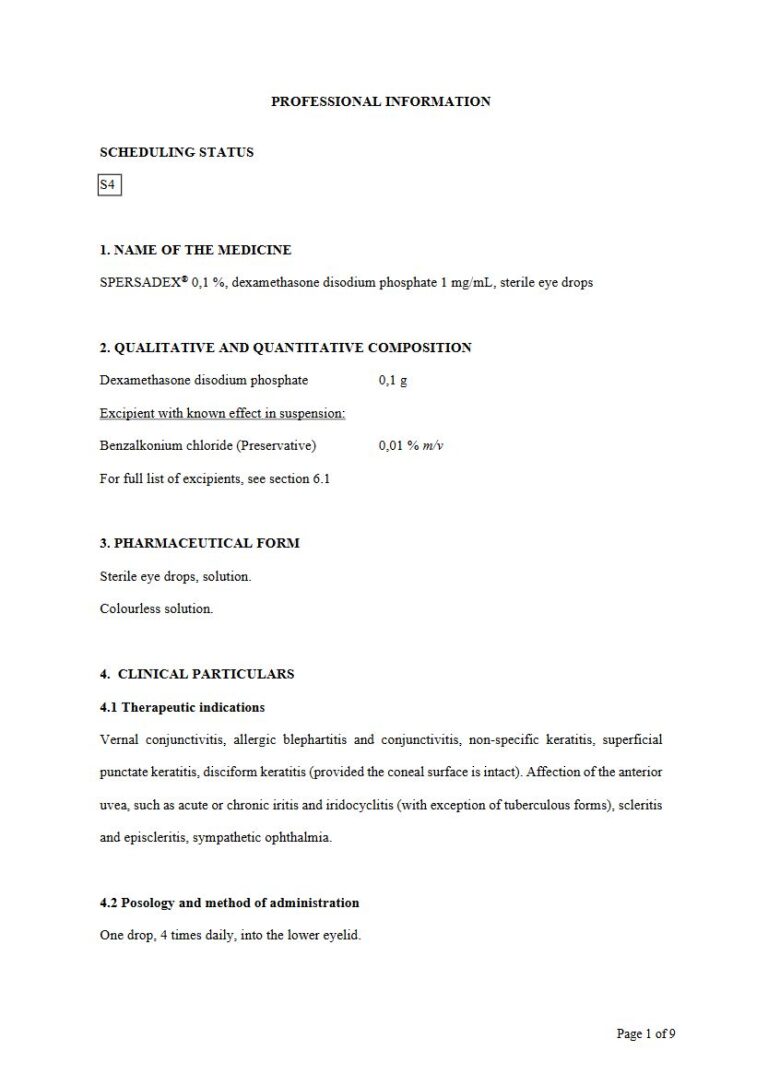
4.1 Therapeutic indications
Vernal conjunctivitis, allergic blephartitis and conjunctivitis, non-specific keratitis, superficial punctate keratitis, disciform keratitis (provided the coneal surface is intact). Affection of the anterior uvea, such as acute or chronic iritis and iridocyclitis (with exception of tuberculous forms), scleritis and episcleritis, sympathetic ophthalmia.
4.2 Posology and method of administration
One drop, 4 times daily, into the lower eyelid.
4.3 Contraindications
- Hypersensitivity to the active ingredient, dexamethasone or to any of the excipients listed in section 6.1.
- Injuries and ulcerations of the cornea, in particular those of bacterial or viral origin (herpes simplex and herpes zoster).
- Purulent infections of the conjunctiva and eye lids.
- Tuberculosis
- Mycoses
- Glaucoma
4.4 Special warnings and precautions for use
As the possibility of adverse effects on the corneal permeability and the danger of disruption of the corneal epithelium with prolonged or repeated use of benzalkonium chloride preserved ophthalmological preparations cannot be excluded, regular ophthalmological examination is required. Caution should be exercised in the use of benzalkonium chloride preserved topical medication over an extended period in patients with extensive ocular surface disease. Because of the possibility of inducing corneal abscess, fungal keratopathy or glaucoma, the patient should be referred to an ophthalmologist if the eye has not responded within 48 hours. Prolonged use of topical ophthalmic corticosteroids such as contained in SPERSADEXu00ae 0,1 %, may result in ocular hypertension and/or glaucoma, with damage to optic nerve, reduced visual acuity, visual field defects and posterior subcapsular cataract formation. In patients receiving prolonged ophthalmic corticosteroid therapy such as SPERSADEXu00ae 0,1 %, intraocular pressure and the lens should be checked routinely and frequently, particularly in patients with a history of glaucoma. This is especially important in paediatric patients as the risk of corticosteroid-induced ocular hypertension may be greater in children and may occur earlier than in adults. The risk of corticosteroid-induced raised intraocular pressure and/or cataract formation is increased in predisposed patients (e.g. diabetes). SPERSADEXu00ae 0,1 % should not be used for longer than one week except under ophthalmic supervision, with regular checks of intraocular pressure. Cushingu2019s syndrome and/or adrenal suppression associated with systemic absorption of ocular dexamethasone may occur after intensive or long-term continuous SPERSADEXu00ae 0,1 % therapy in predisposed patients, including children and patients treated with CYP3A4 inhibitors (including ritonavir and cobicistat). In these cases, SPERSADEXu00ae 0,1 % treatment should be progressively discontinued. Corticosteroids present in SPERSADEXu00ae 0,1 %, may reduce resistance to and aid in the establishment of bacterial, viral, fungal or parasitic infections and mask the clinical signs of infections. In such cases antibiotic therapy is mandatory. Fungal infection should be suspected in patients with persistent corneal ulceration and SPERSADEXu00ae 0,1 % therapy should be discontinued if fungal infection occurs. SPERSADEXu00ae 0,1 % may slow corneal wound healing. Topical NSAIDS are also known to slow or delay healing. Concomitant use of topical NSAIDS and SPERSADEXu00ae 0,1 % may increase the potential for healing problems (see section 4.5) In those diseases causing thinning of the cornea or sclera, perforations have been known to occur with the use of topical corticosteroids such as contained in SPERSADEXu00ae 0,1 %. Visual disturbance may be reported with SPERSADEXu00ae 0,1 % use. If a patient presents with symptoms such as blurred vision or other visual disturbances, the patient should be considered for referral to an ophthalmologist for evaluation of possible causes which may be cataract, glaucoma or rare diseases such as central serous chorioretinopathy (CSCR) which have been reported after use of systemic and topical corticosteroids. The wearing of contact lenses is discouraged during treatment of an ocular inflammation. Additionally, SPERSADEXu00ae 0,1 % contains benzalkonium chloride which may cause irritations and is known to discolour soft contact lenses. Avoid contact with soft contact lenses. However, if the healthcare provider considers contact lenses use appropriate, patients must be instructed to remove contact lenses prior to application of SPERSADEXu00ae 0,1 % and wait at least 15 minutes before reinsertion. There is no evidence of safety in use in children under two years of age. In patients receiving systemic corticosteroids, new-onset or exacerbation of pre-existing diabetes mellitus may occur. Because of the possibility of reduced glucose tolerance/diabetes mellitus with topical ophthalmic corticosteroids, caution is recommended when administering SPERSADEXu00ae 0,1 % to patients with a personal or family history of diabetes.
4.5 Interaction with other medicines and other forms of interaction
No interaction studies have been performed. Concomitant use of SPERSADEXu00ae 0,1 % and topical NSAIDS may increase the potential for corneal healing problems. CYP3A4 inhibitors (including ritonavir and cobicistat) may decrease dexamethasone clearance resulting in increased effects and adrenal suppression/Cushingu2019s syndrome. The combination should be avoided unless the benefit outweighs the increased risk of systemic corticosteroid side-effects, in which case patients should be monitored for systemic corticosteroid effects. If more than one topical ophthalmic medicinal product is being used, the medicines must be administered at least 5 minutes apart. Eye ointments should be administered last. The possibility of a higher need for hypoglycaemic medicinal products must be taken into consideration when administering SPERSADEXu00ae 0,1 % to diabetic patients because the hypoglycaemic effect of these medicinal products may be reduced (see section 4.4).
4.6 Fertility, pregnancy and lactation
Pregnancy
The safety and efficacy in pregnancy has not been established.
Breastfeeding
The safety and efficacy in breastfeeding has not been established.
Fertility
Studies have not been performed to evaluate the effect of topical ocular administration of dexamethasone contained in SPERSADEXu00ae 0,1 % on fertility.
4.7 Effects on ability to drive and use machines
SPERSADEXu00ae 0,1 % has no or negligible influence on the ability to drive and use machines. Temporary blurred vision or other visual disturbances may affect the ability to drive or use machines. If blurred vision occurs upon installation, the patient must wait until the vision clears before driving or using machinery.
4.8 Undesirable effects
a) Summary of the safety profile
The most frequently reported adverse reaction was ocular discomfort.
b) Tabulated list of adverse reactions
MedDRA Systems Organ Class Frequency Description
Immune system disorders Not known Hypersensitivity
Endocrine disorders Not known Cushingu2019s syndrome, adrenal suppression (see section 4.4).
Nervous system disorders Less frequent Dysgeusia Not known Dizziness, headache
Eye disorders Frequent Ocular discomfort
Less frequent Keratitis, conjunctivitis, dry eye, vital dye staining cornea present, photophobia, vision blurred (see section 4.4), eye pruritus, foreign body sensation in eyes, lacrimation increased, abnormal sensation in eyes, eyelid margin crusting, eye irritation, ocular hyperaemia.
Not known Glaucoma, ulcerative keratitis, intraocular pressure increased, visual acuity reduced, corneal erosion, eyelid ptosis, eye pain, mydriasis.
c) Description of selected adverse reactions
Prolonged topical ophthalmic corticosteroids, such as SPERSADEXu00ae 0,1 % may result in increased intraocular pressure with damage to the optic nerve, reduced visual acuity and visual field defects, and to posterior subcapsular cataract formation (see section 4.4). Due to the corticosteroid component in SPERSADEXu00ae 0,1 %, in diseases causing thinning of the cornea or sclera there is a higher risk for perforation especially after long treatments (see section 4.4). SPERSADEXu00ae 0,1 % may reduce resistance to and aid in the establishment of infections (see section 4.4). Cases of corneal calcification have been reported very rarely in association with the use of phosphate containing eye drops in some patients with significantly damaged corneas. SPERSADEXu00ae 0,1 % may impair glucose tolerance, which can lead to new-onset or exacerbation of diabetes mellitus (see section 4.4).
Reporting of suspected adverse reactions
Reporting suspected adverse reactions after authorisation of the medicine is important. It allows continued monitoring of the benefit/risk balance of the medicine. Healthcare providers are asked to report any suspected adverse reactions to SAHPRA via the u201c6.04 Adverse Drug Reactions Reporting Formu201d, found online under SAHPRAu2019s publications: https://www.sahpra.org.za/Publications/Index/8.
4.9 Overdose
If a rise of intracular pressure occurs, the treatment has to be discontinued. Long-term intensive topical use may lead to systemic effects. Oral ingestion of the contents of the bottle (up to 10 mLs) is unlikely to lead to any serious adverse effects. An ocular overdose of SPERSADEXu00ae 0,1 % can be flushed from the eye(s) with lukewarm water.
