
Lotemax Ophthalmic Gel 0,5 % Eye gel
PDF Leaflet Revision Date: 17 October 2022
Clinical Summary
Quick overview from the medicine insert
Indication
Treatment of post-operative inflammation and pain following ocular surgery.
Dosage (summary)
1-2 drops in affected eye(s) four times daily for 2 weeks post-surgery.
Special Populations
- Paediatric patients (birth to 11 years)
- Elderly patients
Pregnancy & Breastfeeding
Not established for pregnancy; contraindicated in breastfeeding.
Key Drug Interactions
- Increased IOP with anticholinergics
- CYP3A inhibitors may increase systemic side effects
Contraindications
- Viral diseases of the cornea
- Hypersensitivity to ingredients
- Fungal infections
Common side effects
- Eye pain
- Anterior chamber inflammation
- Foreign body sensation
Counselling Points
- Do not wear contact lenses during treatment
- Monitor for increased IOP
- Avoid touching the applicator tip
Serious warnings
- Prolonged use may cause glaucoma
- Risk of cataract formation
- Delayed healing
Important Disclaimer
The Lotemax Ophthalmic Gel 0,5 % Eye gel professional information leaflet below is the property of Soflens and is provided on Medinsert exactly as issued, with no.. alterations or editorial changes. We make every effort to keep content current by updating documents as soon as new versions become available. Medinsert serves as a trusted access point for healthcare professionals, but does not replace official sources or clinical judgement. For more details, please read our full disclaimer. read more>>
 Healthcare Professionals Only
This content is for registered healthcare professionals
Sign in or create a free account to read the full package insert.
Free for HPCSA-registered professionals. Powered by Medinsert.
Clinical Particulars
Section 4 of the official insert — extracted exactly as issued, no alterations
4.1 Therapeutic indications
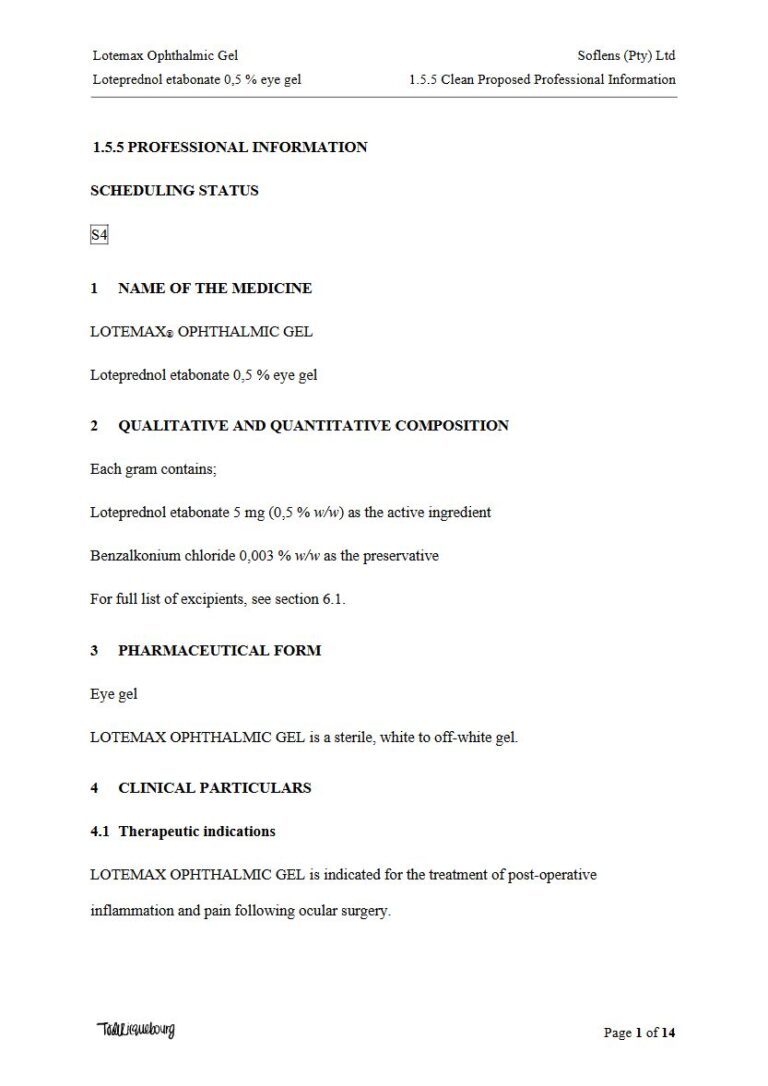
LOTEMAX OPHTHALMIC GEL is indicated for the treatment of post-operative inflammation and pain following ocular surgery.
4.2 Posology and method of administration
Posology
Apply one to two drops of LOTEMAX OPHTHALMIC GEL into the conjunctival sac of the affected eye(s) four times daily beginning the day after surgery and continuing throughout the first two weeks of the post-operative period.
Method of administration
Invert the closed bottle and shake once to fill the tip before instillation. This product is sterile when packaged. To avoid contamination, patients should be advised not to let the applicator tip touch the surface of the eye, fingers, or any other surface. To reduce systemic absorption, it is recommended to compress the lacrimal sac at the medial canthus for at least 2 minutes during and following instillation.
Paediatric population
The safety and effectiveness of LOTEMAX OPHTHALMIC GEL have been established in paediatric patients from birth to 11 years of age (see section 5.1).
Elderly population
No overall differences in safety and effectiveness have been observed between elderly and younger patients.
4.3 Contraindications
LOTEMAX OPHTHALMIC GEL is contraindicated in most viral diseases of the cornea and conjunctiva including epithelial herpes simplex keratitis (dendritic keratitis), vaccinia, varicella, and also in mycobacterial infections of the eye and fungal diseases of ocular structures. LOTEMAX OPHTHALMIC GEL is also contraindicated in individuals with known or suspected hypersensitivity to loteprednol etabonate or any other ingredients of this preparation (see section 6.1) and to other corticosteroids.
4.4 Special warnings and precautions for use
For ophthalmic use only. If pain develops, redness, itching or inflammation become aggravated, the patient should be advised to consult a medical doctor. Benzalkonium chloride has been reported to cause eye irritation, symptoms of dry eyes and may affect the tear film and corneal surface. LOTEMAX OPHTHALMIC GEL should be used with caution in dry eye patients and in patients where the cornea may be compromised. Patients should be monitored in case of prolonged use. As the possibility of adverse effects on the corneal permeability, and the danger of disruption of the corneal epithelium with prolonged or repeated usage of benzalkonium chloride preserved ophthalmological preparations, cannot be excluded, regular ophthalmological examination is required. Caution should be exercised in the use of benzalkonium chloride preserved topical medication over an extended period in patients with extensive ocular surface disease.
Contact lens wear
Patients should not wear contact lenses during their course of therapy with LOTEMAX OPHTHALMIC GEL.
Intraocular pressure (IOP) increase
Prolonged use of corticosteroids may result in glaucoma with damage to the optic nerve, defects in visual acuity and fields of vision. Steroids should be used with caution in the presence of glaucoma. If LOTEMAX OPHTHALMIC GEL is used for 10 days or longer, intraocular pressure should be monitored even though it may be difficult in children and uncooperative patients.
Cataracts
Prolonged use of corticosteroids may result in posterior subcapsular cataract formation.
Delayed healing
The use of steroids after cataract surgery may delay healing and increase the incidence of bleb formation. In those diseases causing thinning of the cornea or sclera, perforations have been known to occur with the use of topical steroids. The initial prescription and renewal of the medication order should be made by a medical doctor only after examination of the patient with the aid of magnification, such as slit lamp biomicroscopy and, where appropriate, fluorescein staining.
Bacterial infections
Prolonged use of corticosteroids may suppress the host response and thus increase the hazard of secondary ocular infections. In acute purulent conditions of the eye, steroids may mask the infection or enhance existing infections.
Viral infections
Use of ocular steroids may prolong the course and may exacerbate the severity of many viral infections of the eye (including herpes simplex). Employment of a corticosteroid medication in the treatment of patients with a history of herpes simplex requires great caution.
Fungal infections
Fungal infections of the cornea are particularly prone to develop coincidentally with long-term local steroid application. Fungus invasion must be considered in any persistent corneal ulceration where a steroid has been used or is in use. Fungal cultures should be taken when appropriate.
4.5 Interaction with other medicines and other forms of interaction
No interaction studies have been performed. Since loteprednol etabonate is not detected in significant amounts in plasma following the topical administration, it is not expected to affect the pharmacokinetics of systemically administered medicinal products. However, the low potential of ocular loteprednol etabonate to increase the intraocular pressure may be adversely affected by systemically administered medicinal products with anticholinergic activity. In patients receiving concomitant ocular hypotensive therapy, the addition of loteprednol etabonate may increase intraocular pressure and decrease the apparent ocular hypotensive effect of these medicinal products. Concurrent administration of cycloplegics may increase the risk of raised intraocular pressure. Co-treatment with CYP3A inhibitors, including cobicistat-containing products, is expected to increase the risk of systemic side-effects. The combination should be avoided unless the benefit outweighs the increased risk of systemic corticosteroid side-effects, in which case patients should be monitored for systemic corticosteroid side-effects.
4.6 Fertility, pregnancy and lactation
Pregnancy
Safety of LOTEMAX OPHTHALMIC GEL in pregnancy has not been established. Teratogenic effects: Loteprednol etabonate has been shown to be embryotoxic and teratogenic when administered to animals. The potential risk for humans is unknown and LOTEMAX OPHTHALMIC GEL should not be used in pregnancy.
Breastfeeding
Systemic steroids appear in human milk and could suppress growth, interfere with endogenous corticosteroid production or cause other untoward effects. Mothers on treatment with LOTEMAX OPHTHALMIC GEL should not breastfeed their babies.
Fertility
There is no human data on the influence of loteprednol etabonate on male and female fertility.
4.7 Effects on ability to drive and use machines
LOTEMAX OPHTHALMIC GEL may cause ocular adverse reactions. If abnormal or blurred vision occurs at instillation, patients should wait until their vision clears before driving or using machinery.
4.8 Undesirable effects
Summary of the safety profile
Adverse reactions associated with ophthalmic steroids include elevated intraocular pressure, which may be associated with optic nerve damage, visual acuity and field defects, posterior subcapsular cataract formation, delayed wound healing and secondary ocular infection from pathogens including herpes simplex, and perforation of the globe where there is thinning of the cornea or sclera. The most common adverse reactions reported in the clinical trials with LOTEMAX OPHTHALMIC GEL (2 u2013 5 %) were anterior chamber inflammation, eye pain, and foreign body sensation.
Tabulated summary of adverse reactions
Treatment-related adverse reactions from clinical trials with loteprednol etabonate ophthalmic gel:
System Organ Class Frequency Adverse reactions
Eye disorders Common (u22651/100 to <1/10) Eye pain, eye lid oedema (in paediatric patients)
Uncommon (u22651/1 000 to <1/100) Anterior chamber inflammation, increased lacrimation, photophobia, eye irritation, eye pruritis, foreign body sensation, dry eye, IOP increased, macular oedema, anterior chamber cell, blurred vision, ocular hyperaemia, ocular discomfort, anterior chamber flare, eyelids pruritis, eye swelling, photopsia, punctate keratitis, pupillary disorder
Skin and subcutaneous tissue disorders Uncommon (u22651/1 000 to <1/100) Facial rash
Gastrointestinal disorders Uncommon (u22651/1 000 to <1/100) Dry mouth
Adverse reactions from spontaneous reporting:
System Organ Class Frequency Adverse reactions
Immune system disorders Frequency unknown Hypersensitivity
Nervous system disorders Frequency unknown Headache
Eye disorders Frequency unknown Eye irritation, ocular hyperaemia, blurred vision, eye swelling, increased lacrimation, eye pruritis, dry eye, photophobia
Gastrointestinal disorders Frequency unknown Nausea
Paediatric population
In a paediatric study of patients between birth and 11 years of age, eyelid oedema was observed in 1,9 % of patients.
Reporting of suspected adverse reactions
Reporting suspected adverse reactions after authorisation of the medicine is important. It allows continued monitoring of the benefit-risk of the medicine. Health care providers are asked to report any suspected adverse reactions to SAHPRA via the u201c6.04 Adverse Drug Reaction Reporting Formu201d, found online under SAHPRAu2019s publications: https://www.sahpra.org.za/Publications/Index/8 You can also report side effects directly to the company, using the following e-mail address: [email protected].
4.9 Overdose
There is hardly a possibility to acutely overdose loteprednol etabonate ophthalmic products since the conjunctival sac has limited capacity and excess volume of medicine administered spill out of the eye surface. There is also virtually no danger expected due to accidental oral ingestion, based on the low bioavailability evidenced in initial human PK studies. Loteprednol etabonate is well-tolerated after the oral ingestion of 40 mg. Systemic safety evaluation in this trial included physical examination, vital sign determination, electrocardiography, and blood/urine sampling for blood chemistry, haematology, and urine analysis. There were no serious, severe, or clinically significant adverse events. All subjects completed the study as planned. Treatment is supportive and symptomatic.
