
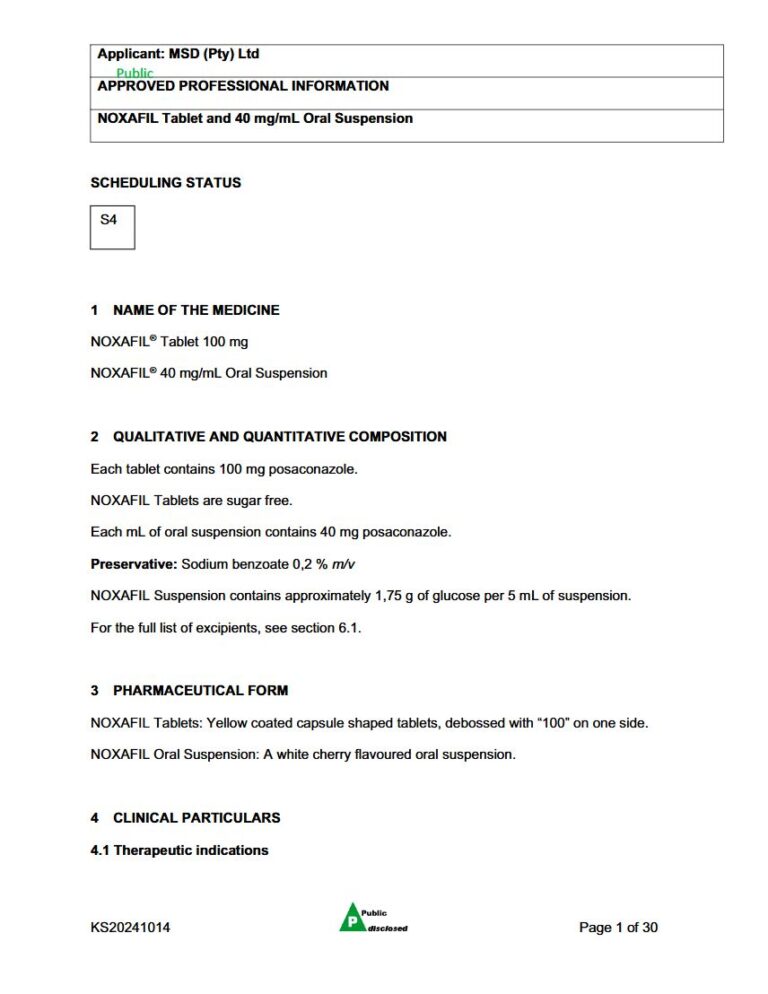
Noxafil 100 Mg Tablets
PDF Leaflet Revision Date: 14 October 2024
Clinical Summary
Quick overview from the medicine insert
Indication
Treatment of refractory fungal infections and prophylaxis in high-risk patients.
Dosage (summary)
Loading dose of 300 mg twice daily on Day 1, then 300 mg once daily for maintenance.
Special Populations
- Renal impairment
- Hepatic impairment
Pregnancy & Breastfeeding
Contraindicated in pregnancy and breastfeeding due to potential risks.
Key Drug Interactions
- CYP3A4 inhibitors
- Ergot alkaloids
- HMG-CoA reductase inhibitors
Contraindications
- Hypersensitivity to posaconazole
Common side effects
- Nausea
- Diarrhoea
- Dizziness
- Elevated liver enzymes
Counselling Points
- Take with food for oral suspension
- Monitor for breakthrough infections
- Avoid certain drug combinations
Serious warnings
- QT prolongation
- Hepatic toxicity
- Vincristine toxicity
Important Disclaimer
The Noxafil 100 Mg Tablets professional information leaflet below is the property of Msd and is provided on Medinsert exactly as issued, with no.. alterations or editorial changes. We make every effort to keep content current by updating documents as soon as new versions become available. Medinsert serves as a trusted access point for healthcare professionals, but does not replace official sources or clinical judgement. For more details, please read our full disclaimer. read more>>
 Healthcare Professionals Only
This content is for registered healthcare professionals
Sign in or create a free account to read the full package insert.
Free for HPCSA-registered professionals. Powered by Medinsert.
Clinical Particulars
Section 4 of the official insert — extracted exactly as issued, no alterations
4.1 Therapeutic indications
NOXAFIL Tablets and Oral Suspension are indicated for use in the treatment of the following fungal infections in patients 13 years of age or older:
- Oesophageal candidiasis or candidemia in patients with disease that is refractory to other appropriate antifungal agents (amphotericin B, fluconazole or itraconazole). Refractoriness is defined as progression of infection or failure to improve after a minimum of 7 days of prior therapeutic doses of effective antifungal therapy.
- Invasive aspergillosis in patients with disease that is refractory to amphotericin B, itraconazole or voriconazole or in patients who are intolerant of these medicinal products. Refractoriness is defined as a progression of infection or failure to improve after a minimum of 7 days of prior therapeutic doses of effective antifungal therapy.
- Fusariosis, zygomycosis, cryptococcosis, chromoblastomycosis and mycetoma in patients with disease refractory to other therapy or patients who are intolerant of other therapy.
- Coccidioidomycosis.
NOXAFIL Tablets and Oral Suspension are also indicated for prophylaxis of invasive fungal infections in patients who are at high risk of developing these infections, such as patients with prolonged neutropenia or haematopoietic stem cell transplant (HSCT) recipients. NOXAFIL Oral Suspension is also indicated for use in the treatment of the following fungal infections in patients 13 years of age or older:
- Oropharyngeal candidiasis, including in patients with disease that is refractory to itraconazole and fluconazole. Refractoriness is defined as progression of infection or failure to improve after a minimum of 7 days of prior therapeutic doses of effective antifungal therapy.
4.2 Posology and method of administration
Non-interchangeability between NOXAFIL Tablets and NOXAFIL Oral Suspension
NOXAFIL Tablets and Oral Suspension are not to be used interchangeably due to the difference in the dosing of each formulation. Therefore, follow the specific dosage recommendation for each of the formulations.
Table 1: Recommended Dose for Noxafil Tablets according to Indication
| Indication | Dose and Duration of therapy |
|---|---|
| Prophylaxis of Invasive Fungal Infections | Loading dose of 300 mg (three 100 mg tablets) twice a day on the first day, then 300 mg (three 100 mg tablets) once a day thereafter. Each dose may be taken without regard to food intake. Duration of therapy is based on recovery from neutropenia or immunosuppression. For patients with acute myelogenous leukaemia or myelodysplastic syndromes, prophylaxis with NOXAFIL should start several days before the anticipated onset of neutropenia and continue for 7 days after the neutrophil count rises above 500 cells per mm3. |
| Refractory Invasive Fungal Infections (IFI)/Patients with IFI intolerant to 1st line therapy | Loading dose of 300 mg (three 100 mg tablets) twice a day on the first day, then 300 mg (three 100 mg tablets) once a day thereafter. Duration of therapy should be based on the severity of the underlying disease, recovery from immunosuppression and clinical response. |
| Coccidioidomycosis | Refractory Oesophageal Candidiasis Loading dose of 300 mg (three 100 mg tablets) twice a day on the first day, then 300 mg (three 100 mg tablets) once a day thereafter. Each dose may be taken without regard to food intake. Duration of therapy should be based on the severity of the underlying disease, recovery from immunosuppression and clinical response. |
Table 2: Recommended Dose for Noxafil Oral Suspension According to Indication
| Indication | Dose and Duration of Therapy |
|---|---|
| Refractory Invasive Fungal Infections (IFI)/Intolerant Patients with IFI | 400 mg (10 mL) twice a day. In patients who cannot tolerate a meal or a nutritional supplement, NOXAFIL should be administered at a dose of 200 mg (5 mL) four times a day. Duration of therapy should be based on the severity of the underlying disease, recovery from immunosuppression and clinical response. |
| Coccidioidomycosis | 400 mg (10 mL) twice a day. In patients who cannot tolerate a meal or nutritional supplement, NOXAFIL should be administered a dose of 200 mg (5 mL) four times a day. Duration of therapy should be based on the severity of the underlying disease, recovery from immunosuppression and clinical response. |
| Oropharyngeal Candidiasis | Loading dose of 200 mg (5 mL) once a day on the first day, then 100 mg (2.5 mL) once a day for 13 days. |
| Refractory Oropharyngeal or Oesophageal Candidiasis | 400 mg (10 mL) twice a day. Duration of the therapy should be based on the severity of the patientu2019s underlying disease and clinical response. |
| Prophylaxis of Invasive Fungal Infections | 200 mg (5 mL) three times a day. The duration of therapy is based on recovery from neutropenia or immunosuppression. |
Increasing the total daily dose of oral suspension above 800 mg does not further enhance the exposure to NOXAFIL.
Use in renal impairment: No dose adjustment is required for renal dysfunction and as NOXAFIL is not significantly renally eliminated, an effect of severe renal insufficiency on the pharmacokinetics of NOXAFIL is not expected and no dose adjustment is recommended.
Use in hepatic impairment: There are limited pharmacokinetic data in patients with hepatic insufficiency, but do not suggest that dose adjustment is necessary. In the small number of subjects studied who had hepatic insufficiency, there was an increase in half-life in subjects with decreased in hepatic function.
Use in Paediatrics: Safety and efficacy in adolescents and children below the age of 13 years have not been established.
Method of Administration
NOXAFIL Tablets and Oral Suspension are intended for oral administration only. NOXAFIL Tablets can be taken without regard to food. NOXAFIL Tablets should be swallowed whole, and not be divided, crushed or chewed. Shake NOXAFIL Oral Suspension well before use. This medicine should not be used after 4 weeks after first opening. NOXAFIL Oral Suspension must be administered with a meal, or with 240 mL of a nutritional supplement.
4.3 Contraindications
NOXAFIL is contraindicated in patients with known hypersensitivity to posaconazole or any component of the product.
4.4 Special warnings and precautions for use
Hypersensitivity: There is no information regarding cross-sensitivity between NOXAFIL and other azole antifungal agents. Caution should be used when prescribing NOXAFIL to patients with hypersensitivity to other azoles.
Hepatic toxicity: In clinical trials, there were infrequent cases of hepatic reactions (e.g. mild to moderate elevations in ALT, AST, alkaline phosphatase, total bilirubin and/or clinical hepatitis). The elevations in liver function tests were generally reversible on discontinuation of therapy and in some instances these tests normalised without drug interruption and rarely required drug discontinuation. Rarely, more severe hepatic reactions including cholestasis or hepatic failure were reported in patients with serious underlying medical conditions (e.g. haematologic malignancy) during treatment with NOXAFIL.
QT prolongation: Some azoles have been associated with prolongation of QT interval. Results from a multiple time-matched ECG analysis in healthy volunteers did not show any increase in the mean of the QTc interval. Nevertheless, NOXAFIL should not be administered with medications that are known to prolong QTc interval and are metabolised through CYP3A4.
Electrolyte disturbances: Especially those involving potassium, magnesium or calcium levels should be monitored and corrected as necessary before and during NOXAFIL therapy.
Vincristine Toxicity: Concomitant administration of azole antifungals, including posaconazole, with vincristine has been associated with neurotoxicity and other serious adverse reactions, including seizures, peripheral neuropathy, syndrome of inappropriate antidiuretic hormone secretion and paralytic ileus. Reserve azole antifungals including posaconazole, for patients receiving a vinca alkaloid including vincristine, who have no alternative antifungal treatment options (see section 4.5).
Venetoclax Toxicity: Concomitant administration of Posaconazole with venetoclax (a CYP3A4 substrate) may increase venetoclax toxicities, including the risk of tumor lysis syndrome (TLS) and neutropenia (see 4.5 Interactions with Other Medicinal Products and Other Forms of Interaction). Refer to the venetoclax prescribing information for detailed guidance.
Glucose: NOXAFIL Oral Suspension contains approximately 1.75 g of glucose per 5 mL of suspension. Patients with rare glucose-galactose malabsorption should not take this medicine.
4.5 Interaction with other medicinal products and other forms of interaction
The interactions described in the following subsections apply to posaconazole tablets and oral suspension unless otherwise specified.
Effects of other medicinal products on NOXAFIL Tablets and Oral Suspension
NOXAFIL is metabolised via UDP glucuronidation (phase 2 enzymes) and is a substrate for p-glycoprotein (P-gp) efflux. Therefore, inhibitors or inducers of these clearance pathways may affect NOXAFIL plasma concentrations.
Rifabutin (300 mg once a day) decreased the C max (maximum plasma concentration) and AUC (area under the plasma concentration curve) of NOXAFIL by 43 % and 49 % respectively. Concomitant use of NOXAFIL and rifabutin should be avoided.
Phenytoin (200 mg once a day) decreased the C max and AUC of NOXAFIL by 41 % and 50 %, respectively. Concomitant use of NOXAFIL and phenytoin should be avoided.
H2 receptor antagonists, proton pump inhibitors (PPIs) and antacids
NOXAFIL Tablets: No clinically relevant effect was observed when NOXAFIL Tablets are used concomitantly with an antacid, H2 receptor antagonists and other proton pump inhibitors. No dose adjustments of NOXAFIL Tablets is required when used concomitantly with these products.
NOXAFIL Oral Suspension: Plasma concentrations (C max and AUC) were reduced by 39 % when NOXAFIL Oral Suspension was administered with cimetidine (400 mg twice a day) due to reduced absorption possibly secondary to a decrease in gastric acid production. Co-administration of NOXAFIL Oral Suspension with H2 receptor antagonists should be avoided if possible. Similarly, administration of 400 mg NOXAFIL Oral Suspension with esomeprazole (40 mg daily) decreased mean C max and AUC by 46 % and 32 %, respectively, compared to dosing with 400 mg posaconazole alone. Co-administration of NOXAFIL Oral Suspension with proton pump inhibitors should be avoided if possible.
Gastrointestinal Motility Agents
NOXAFIL Tablets: No clinically meaningful effect on the pharmacokinetics of posaconazole was observed when NOXAFIL Tablets were concomitantly administered with metoclopramide. No dosage adjustment of NOXAFIL Tablets is required when given concomitantly with metoclopramide.
NOXAFIL Oral Suspension: Metoclopramide, when given with NOXAFIL Oral Suspension, decreases posaconazole plasma concentrations. If metoclopramide is concomitantly administered with NOXAFIL Oral Suspension, it is recommended to closely monitor for breakthrough fungal infections. Loperamide does not affect posaconazole plasma concentrations. No dosage adjustment of NOXAFIL Oral Suspension is required when loperamide and posaconazole are used concomitantly.
Glipizide (10 mg single dose) had no clinically significant effect on NOXAFIL C max and AUC.
Efavirenz (400 mg once a day) decreased the C max and AUC of posaconazole by 45 % and 50 %, respectively. Concomitant use of posaconazole and efavirenz should be avoided.
Fosamprenavir: Combining fosamprenavir with posaconazole may lead to decreased posaconazole plasma concentrations. If concomitant administration is required, close monitoring for breakthrough fungal infections is recommended. Repeat dose administration of fosamprenavir (700 mg twice daily x 10 days) decreased the C max and AUC of posaconazole (200 mg oral suspension daily on the 1st day, 200 mg oral suspension twice daily on the 2nd day, then 400 mg oral suspension twice daily x 8 Days) by 21 % and 23 %, respectively.
Effects of NOXAFIL Tablets and Oral Suspension on other medicinal products
NOXAFIL is not metabolised to a clinically significant extent through the cytochrome P450 system. However, NOXAFIL is an inhibitor of CYP3A4 and thus the plasma levels of drugs that are metabolised through this enzyme pathway may increase when administered with NOXAFIL.
Ergot alkaloids: NOXAFIL may increase the plasma concentration of ergot alkaloids (ergotamine and dihydroergotamine), which may lead to ergotism. Co-administration of NOXAFIL and ergot alkaloids is contraindicated (see section 4.3).
Vinca alkaloids: Most of the vinca alkaloids (e.g. vincristine and vinblastine) are substrates of CYP3A4. Concomitant administration of azole antifungals, including posaconazole, with vincristine has been associated with serious adverse reactions (see section 4.4). Posaconazole may increase the plasma concentrations of vinca alkaloids which may lead to neurotoxicity and other serious adverse reactions. Therefore, reserve azole antifungals, including posaconazole, for patients receiving a vinca alkaloid, including vincristine, who have no alternative antifungal treatment options.
Ciclosporin: In heart transplant patients on stable doses of ciclosporin, NOXAFIL 200 mg once daily increased ciclosporin concentrations requiring dose reductions. When initiating treatment with NOXAFIL in patients already receiving ciclosporin, the dose of ciclosporin should be reduced (e.g. to about three fourths of the current dose). Thereafter blood levels of ciclosporin should be monitored carefully during co-administration and upon discontinuation of NOXAFIL treatment, the dose of ciclosporin should be adjusted as necessary.
Tacrolimus: NOXAFIL increased C max and AUC of tacrolimus (0.05 mg/kg single dose) by 121 % and 358 % respectively. When initiating NOXAFIL treatment in patients already receiving tacrolimus, the dose of tacrolimus should be reduced (e.g. to about one third of the current dose). Thereafter blood levels of tacrolimus should be monitored carefully during co-administration and upon discontinuation of NOXAFIL, and the dose of tacrolimus should be adjusted as necessary.
Sirolimus: Repeat dose administration of oral posaconazole (400 mg oral suspension twice daily for 16 days) increased the C max and AUC of sirolimus (2 mg single dose) an average of 6.7-fold and 8.9-fold, respectively, in healthy subjects. When initiating therapy in patients already taking sirolimus, the dose of sirolimus should be reduced (e.g. to about 1/10 of the current dose) with frequent monitoring of sirolimus whole blood trough concentrations. Sirolimus concentrations should be performed upon initiation, during co-administration and at discontinuation of NOXAFIL treatment, with sirolimus doses adjusted accordingly.
Rifabutin: NOXAFIL increased the C max and AUC of rifabutin by 31 % and 72 % respectively. Concomitant use of NOXAFIL and rifabutin should be avoided unless the benefit to the patient outweighs the risk. If the drugs are co-administered, careful monitoring of full blood counts and adverse effects related to increased rifabutin levels (e.g. uveitis) is recommended.
Midazolam: Repeat dose administration of oral posaconazole (200 mg oral suspension twice daily for 7 days) increased the C max and AUC of IV midazolam (0.4 mg single dose) an average of 1.3- and 4.6-fold, respectively; NOXAFIL 400 mg oral suspension twice daily for 7 days increased the IV midazolam C max and AUC by 1.6- and 6.2-fold, respectively. Both doses of posaconazole increased C max and AUC of oral midazolam (2 mg single oral dose) by 2.2- and 4.5-fold, respectively. In addition, oral NOXAFIL (200 mg or 400 mg oral suspension) prolonged the mean terminal half-life of midazolam from approximately 3 to 4 hours to 8 to 10 hours during co-administration. It is recommended that dose adjustments of benzodiazepines metabolised by CYP3A4 be considered during co-administration with NOXAFIL.
Zidovudine (AZT), lamivudine (3TC), indinavir: Clinical studies demonstrated that no clinically significant effects on zidovudine, lamivudine, indinavir were observed when administered with NOXAFIL; therefore, no dose adjustments are required for these co-administered drugs.
HIV Protease Inhibitors: As HIV protease inhibitors are CYP3A4 substrates, it is expected that NOXAFIL will increase plasma levels of these antiretroviral medicines. Repeat dose administration of oral posaconazole (400 mg oral suspension twice daily for 7 days) increased the C max and AUC of atazanavir (300 mg once a day for 7 days) an average of 2.6-fold and 3.7-fold, respectively, in healthy subjects. Repeat dose administration of NOXAFIL (400 mg oral suspension twice daily for 7 days) increased the C max and AUC of atazanavir to a lesser extent when administered as a boosted regimen with ritonavir (300 mg atazanavir plus ritonavir 100 mg once a day for 7 days) with an average of 1.5-fold and 2.5-fold, respectively, in healthy subjects. Frequent monitoring for adverse events and toxicity related to antiretroviral agents that are substrates of CYP3A4 is recommended during co-administration with NOXAFIL.
HMG-CoA reductase inhibitors primarily metabolised through CYP3A4: Repeat dose administration of oral NOXAFIL (50, 100 and 200 mg oral suspension once daily for 13 days) increased the C max and AUC of simvastatin (40 mg single dose) an average of 7.4 to 11.4-fold and 5.7 to 10.6-fold, respectively. Increased HMG-CoA reductase inhibitor concentrations in plasma can be associated with rhabdomyolysis. Co-administration of posaconazole and HMG-CoA reductase inhibitors primarily metabolised through CYP3A4 is contraindicated (see section 4.3).
Calcium channel blockers metabolised through CYP3A4: Frequent monitoring for adverse events and toxicity related to calcium channel blockers is recommended during co-administration with NOXAFIL. Dose adjustment of calcium channel blockers may be required.
Digoxin: Administration of other azoles has been associated with increases in digoxin levels. Therefore, NOXAFIL may increase plasma concentration of digoxin and digoxin levels need to be monitored when initiating or discontinuing NOXAFIL treatment.
Venetoclax: Concomitant use of venetoclax (a CYP3A4 substrate) with Posaconazole increases venetoclax C max and AUC 0-INF, which may increase venetoclax toxicities (see 4.4 Special Warnings and Special Precautions for Use).
4.6 Fertility, pregnancy and lactation
Pregnancy
Studies in animals have shown reproductive toxicity. NOXAFIL has been shown to cause skeletal malformations in rats at exposures lower than those obtained at therapeutic doses in humans. In rabbits NOXAFIL was embryotoxic at exposures greater than those obtained at therapeutic doses. The potential risk to humans is unknown. NOXAFIL should not be used during pregnancy.
Breastfeeding
NOXAFIL is excreted into the milk of lactating rats. The excretion of NOXAFIL in human breast milk has not been investigated. NOXAFIL should not be used by breastfeeding mothers.
4.7 Effects on ability to drive and use machines
Since certain adverse reactions (e.g. dizziness, somnolence, etc.) have been reported with posaconazole use, which potentially may affect driving/operating machinery, caution needs to be used.
4.8 Undesirable effects
Summary of the safety profile
NOXAFIL Tablets: The safety of NOXAFIL Tablets has been assessed in 230 patients enrolled in the pivotal clinical study. Patients were enrolled in a non-comparative pharmacokinetic and safety trial of NOXAFIL Tablets when given as antifungal prophylaxis. Patients were immunocompromised with underlying conditions including haematological malignancy, neutropenia post-chemotherapy, Graft versus Host Disease (GVHD), and post HSCT. NOXAFIL Tablets therapy was given for a median duration of 28 days. Twenty patients received 200 mg daily dose and 210 patients received 300 mg daily dose (following twice daily dosing on Day 1 in each cohort). The most frequently reported treatment-related adverse reactions (u2265 5 %) with NOXAFIL Tablets (300 mg once daily) were nausea and diarrhoea. The most frequently reported adverse reaction leading to discontinuation of NOXAFIL Tablets 300 mg once daily was nausea.
NOXAFIL Oral Suspension: The safety of NOXAFIL Oral Suspension has been assessed in 2 400 patients and healthy volunteers enrolled in clinical trials and from post-marketing experience, 172 patients received NOXAFIL therapy for u2265 6 months, 58 of these received NOXAFIL therapy for u2265 12 months. Treatment related serious adverse events reported 428 patients with invasive fungal infections (1 % each) included altered concentration of other medicinal products, increased hepatic enzymes, nausea, rash and vomiting. Treatment-related serious adverse events reported in 605 patients treated with NOXAFIL Oral Suspension for prophylaxis (1 % each) included bilirubinaemia, increased hepatic enzymes, hepatocellular damage, nausea and vomiting. Uncommon and rare treatment related medically significant adverse events reported during clinical trials with NOXAFIL Oral Suspension have included adrenal insufficiency (causality not confirmed), pancreatitis, allergic and/or hypersensitivity reactions.
In addition, rare cases of torsade de pointes have been reported in patients taking NOXAFIL. In addition, rare cases of haemolytic uraemic syndrome and thrombotic thrombocytopenic purpura have been reported primarily among patients who have been receiving concomitant ciclosporin or tacrolimus with NOXAFIL oral suspension for management of transplant rejection or graft vs. host disease.
Treatment-related adverse reactions (TRAEs) reported in NOXAFIL Tablets and Oral Suspension studies: The most common treatment-related adverse reactions reported in NOXAFIL Tablets and Oral Suspension studies across the whole population of healthy volunteers and patients are shown in Table 3.
Table 3: Treatment-related adverse reactions (TRAEs) reported in NOXAFIL Tablets and Oral Suspension dosed subjects by body system n=2 400. Includes all TRAEs with incidence of 1 % or higher
Common (u2265 1/100 to < 1/10)
Blood and lymphatic system disorders
Common Neutropenia
Metabolism and nutrition disorders
Common Anorexia, electrolyte imbalance, hypokalaemia
Nervous system disorders
Common Dizziness, headache, paraesthesia, somnolence
Gastrointestinal disorders
Common Abdominal pain, diarrhoea, dyspepsia, flatulence, dry mouth, nausea, vomiting, constipation
Hepatobiliary disorders
Common Elevated liver function tests (including AST, ALT, alkaline phosphatase, GGT, bilirubin)
Skin and subcutaneous tissue disorders
Common Rash, pruritis
General disorders and administration site conditions
Common Asthenia, fatigue, pyrexia (fever)
Post-marketing experience
The following post-marketing adverse experience has been reported: Endocrine disorders: pseudoaldosteronism.
4.9 Overdose
There is no experience with overdosage of NOXAFIL Tablets. During the clinical trials, some patients received NOXAFIL Oral Suspension up to 1 600 mg/day with no adverse events noted that were different from the lower doses. In addition, accidental overdose was noted in one patient who took 1200 mg NOXAFIL oral suspension twice a day for 3 days. No adverse events were noted by the investigator. NOXAFIL is not removed by haemodialysis. Treatment is supportive and symptomatic.
