
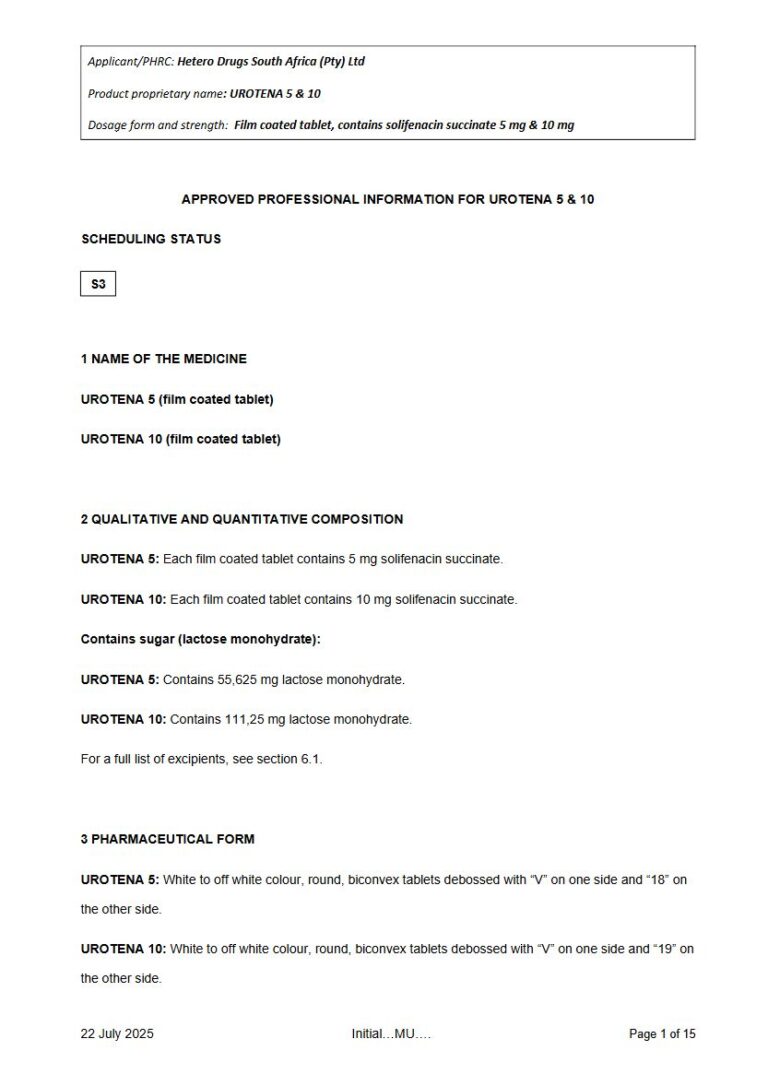
Uroten 5 mg & 10 mg FC tablet
PDF Leaflet Revision Date: 22 July 2025
Clinical Summary
Quick overview from the medicine insert
Indication
Symptomatic treatment of overactive bladder syndrome.
Dosage (summary)
5 mg once daily, may increase to 10 mg once daily.
Special Populations
- Renal impairment
- Hepatic impairment
Pregnancy & Breastfeeding
Contraindicated in pregnancy; not recommended during breastfeeding.
Key Drug Interactions
- CYP3A4 inhibitors (e.g., ketoconazole)
- Anticholinergic medications
Contraindications
- Hypersensitivity to solifenacin
- Urinary retention
- Uncontrolled narrow angle glaucoma
- Myasthenia gravis
- Toxic megacolon
- Severe renal impairment
- Severe hepatic impairment
Common side effects
- Dry mouth
- Constipation
- Blurred vision
- Somnolence
Counselling Points
- Take orally with or without food.
- May cause blurred vision; caution with driving.
- Report any signs of allergic reactions.
Serious warnings
- QT prolongation risk
- Angioedema
- Anaphylactic reactions
Important Disclaimer
The Uroten 5 mg & 10 mg FC tablet professional information leaflet below is the property of Hetero Drugs South Africa and is provided on Medinsert exactly as issued, with no.. alterations or editorial changes. We make every effort to keep content current by updating documents as soon as new versions become available. Medinsert serves as a trusted access point for healthcare professionals, but does not replace official sources or clinical judgement. For more details, please read our full disclaimer. read more>>
 Healthcare Professionals Only
This content is for registered healthcare professionals
Sign in or create a free account to read the full package insert.
Free for HPCSA-registered professionals. Powered by Medinsert.
Clinical Particulars
Section 4 of the official insert — extracted exactly as issued, no alterations
4.1 Therapeutic indications
UROTENA is indicated for the symptomatic treatment of overactive bladder syndrome: symptoms of urinary urgency, frequent micturition and/or urge incontinence.
4.2 Posology and method of administration
Posology
Adults, including the elderly
The recommended dose is 5 mg once daily. If needed, the dose may be increased to 10 mg once daily.
Children
Safety and effectiveness of UROTENA in children have not yet been established. Therefore, UROTENA is not recommended for children.
Special populations
Patients with renal impairment: No dose adjustment is necessary for patients with mild to moderate renal impairment (creatinine clearance > 30 ml/min). Patients with severe renal impairment (creatinine clearance u2264 30 ml/min) should be treated with caution and receive not more than 5 mg once daily.
Patients with hepatic impairment: No dose adjustment is necessary for patients with mild hepatic impairment. Patients with moderate hepatic impairment should be treated with caution and receive not more than 5 mg once daily.
Potent inhibitors of cytochrome P450 3A4: The maximum dose of UROTENA should be limited to 5 mg when treated simultaneously with ketoconazole or therapeutic doses of other potent CYP3A4-inhibitors e.g. ritonavir, nelfinavir, itraconazole.
Method of administration
UROTENA should be taken orally and should be swallowed whole with liquids. It can be taken with or without food, as is convenient.
4.3 Contraindications
- Known hypersensitivity to solifenacin or to any of the excipients of UROTENA (see section 6.1).
- Urinary retention.
- Uncontrolled narrow angle glaucoma.
- Myasthenia gravis.
- Toxic megacolon.
- Patients undergoing haemodialysis.
- Patients with severe hepatic impairment.
- Patients with severe renal impairment (Cl cr < 30 ml/min) and on treatment with a strong CYP3A4 inhibitor, e.g. ketoconazole (see section 4.5).
- Patients with moderate hepatic impairment and on treatment with a strong CYP3A4 inhibitor, e.g. ketoconazole (see section 4.5).
- Patients with a prolonged QT interval, either congenital or acquired.
- Pregnancy and lactation (see section 4.6).
4.4 Special warnings and precautions for use
Organic reasons for urge and frequent micturition should be excluded before treatment. UROTENA should be used with caution in patients with:
- Significant decompensated bladder outlet obstruction at risk of urinary retention.
- Gastrointestinal obstructive disorders.
- Risk of decreased gastrointestinal motility.
- Severe renal impairment (creatinine clearance u2264 30 ml/min), and doses should not exceed 5 mg for these patients.
- Moderate hepatic impairment, and doses should not exceed 5 mg for these patients.
- Concomitant use of a potent CYP3A4 inhibitor, e.g. ketoconazole.
- Hiatus hernia/gastro-oesophagal reflux and/or who are concurrently taking medicines (such as bisphosphonates) that can cause or exacerbate oesophagitis.
- Autonomic neuropathy.
QT prolongation and Torsade de Pointes have been observed in patients with risk factors, such as pre-existing long QT syndrome and hypokalaemia (see section 4.3). Safety and efficacy have not yet been established in patients with a neurogenic cause for detrusor overactivity. Angioedema with airway obstruction has been reported in some patients on UROTENA. If angioedema occurs, UROTENA should be discontinued and appropriate therapy and/or measures should be taken.
Anaphylactic reaction has been reported in some patients treated with UROTENA. In patients who develop anaphylactic reactions, UROTENA should be discontinued and appropriate therapy and/or measures should be taken.
The maximum effect of UROTENA can be determined after 4 weeks at the earliest.
Lactose warning
UROTENA contains lactose. Patients with rare hereditary problems of galactose intolerance, total lactase deficiency or glucose-galactose malabsorption should not take this medicine.
4.5 Interaction with other medicine and other forms of interaction
Pharmacological interactions
Concomitant medication with other medicines with anticholinergic properties may result in more pronounced therapeutic effects and side effects. An interval of approximately one week should be allowed after stopping treatment with UROTENA, before commencing other anticholinergic therapy. The therapeutic effect of UROTENA may be reduced by concomitant administration of cholinergic receptor agonists. UROTENA can reduce the effect of medicines that stimulate the motility of the gastro-intestinal tract, such as metoclopramide and cisapride.
Pharmacokinetic interactions
In vitro studies have demonstrated that at therapeutic concentrations, solifenacin does not inhibit CYP1A/2, 2C9, 2C19, 2D6, or 3A4 derived from human liver microsomes. Therefore, UROTENA is unlikely to alter the clearance of medicines metabolised by these CYP enzymes.
Effect of other medicines on the pharmacokinetics of solifenacin
Since solifenacin is metabolised by CYP3A4, pharmacokinetic interactions are possible with other CYP3A4 substrates, inhibitors and inducers. Simultaneous administration of ketoconazole (200 mg/day) resulted in a two-fold increase of the AUC of solifenacin, while ketoconazole at a dose of 400 mg/day resulted in a three-fold increase of the AUC of solifenacin. Therefore, the maximum dose of UROTENA should be restricted to 5 mg, when used simultaneously with ketoconazole or therapeutic doses of other potent CYP3A4 inhibitors (e.g. ritonavir, nelfinavir, itraconazole). Simultaneous treatment of UROTENA and strong CYP3A4 inhibitor is contraindicated in patients with severe renal impairment or moderate hepatic impairment (see section 4.3). The effects of enzyme induction on the pharmacokinetics of solifenacin and its metabolites have not been studied as well as the effect of higher affinity CYP3A4 substrates on solifenacin exposure.
Effect of solifenacin on the pharmacokinetics of other medications
Oral contraceptives: Intake of UROTENA showed no pharmacokinetic interaction between solifenacin and combined oral contraceptives (ethinyl oestradiol / levonorgestrel), both CYP3A4 substrates. Warfarin: Intake of UROTENA did not alter the pharmacokinetics of R-warfarin (substrate for CYP3A4) or S-warfarin (substrate for CYP2C9) or their effect on the INR. Digoxin: Intake of UROTENA showed no effects on the pharmacokinetics of digoxin.
4.6 Fertility, pregnancy and lactation
Pregnancy
UROTENA is contraindicated during pregnancy (see section 4.3). Foetal toxicity has been shown in rodents.
Lactation
Solifenacin is excreted into breast milk. Women taking UROTENA should not breastfeed their infants.
4.7 Effects on ability to drive and use machines
Since UROTENA may cause blurred vision, somnolence and fatigue (see section 4.8), the ability to drive and use machines may be negatively affected.
4.8 Undesirable effects
a) Summary of the safety profile
Due to the pharmacological effect of solifenacin, UROTENA may cause anticholinergic undesirable effects of (in general) mild or moderate severity. The frequency of anticholinergic side effects is dose related. The most commonly reported adverse reaction with solifenacin, was dry mouth. It occurred in 11 % of patients treated with 5 mg once daily, in 22 % of patients treated with 10 mg once daily and in 4 % of placebo-treated patients. The severity of dry mouth was generally mild.
b) Tabulated summary of adverse reactions
Infections and infestations
Less frequent: Urinary tract infection, cystitis
Immune system disorders
Frequency unknown: Anaphylactic reaction
Metabolism and nutrition disorders
Frequency unknown: Decreased appetite, hyperkalaemia
Psychiatric disorders
Less frequent: Hallucinations, confusional state
Frequency unknown: Delirium
Nervous system disorders
Less frequent: Somnolence, dysgeusia, dizziness, headache
Frequency unknown: Glaucoma
Eye disorders
Frequent: Blurred vision
Less frequent: Dry eyes
Cardiac disorders
Frequency unknown: Torsade de Pointes, electrocardiogram, QT prolonged
Respiratory, thoracic and mediastinal disorders
Less frequent: Nasal dryness
Frequency unknown: Dysphonia
Gastrointestinal disorders
Frequent: Dry mouth, constipation, nausea, dyspepsia, abdominal pain
Less frequent: Gastro-oesophageal reflux diseases, dry throat, colonic obstruction, faecal impaction
Frequency unknown: Illeus, abdominal discomfort
Hepato-biliary disorders
Frequency unknown: Liver disorder, liver function test abnormal
Skin and subcutaneous tissue disorders
Less frequent: Dry skin, pruritus, rash, erythema multiforme, urticaria, angioedema
Frequency unknown: Exfoliative dermatitis
Musculoskeletal and connective tissue disorders
Frequency unknown: Muscular weakness
Renal and urinary disorders
Less frequent: Difficulty in micturition, urinary retention
Frequency unknown: Renal impairment
General disorders and administration site conditions
Less frequent: Fatigue, peripheral oedema
Reporting of suspected adverse reactions
Reporting suspected adverse reactions after authorisation of the medicine is important. It allows continued monitoring of the benefit/risk balance of the medicine. Health care providers are asked to report any suspected adverse to report any suspected adverse reactions via the Med Safety APP (Medsafety X SAHPRA) and eReporting platform (who-umc.org) found on SAHPRA website, and to the Holder of certificate of registration through the mail: [email protected].
4.9 Overdose
Overdosage with solifenacin succinate can potentially result in severe anticholinergic effects.
Treatment
In the event of overdose with UROTENA the patient should be treated with activated charcoal. As for other anticholinergics, symptoms can be treated as follows:
- Severe central anticholinergic effects such as hallucinations or pronounced excitation: treat with physostigmine or carbachol.
- Convulsions or pronounced excitation: treat with benzodiazepines.
- Respiratory insufficiency: treat with artificial respiration.
- Tachycardia: treat with beta-blockers.
- Urinary retention: treat with catheterisation.
- Mydriasis: treat with pilocarpine eye drops and/or place patient in dark room.
Specific attention should be paid to patients with known risk for QT-prolongation (i.e. hypokalaemia, bradycardia and concurrent administration of medicinal products known to prolong QT-interval) and relevant pre-existing cardiac diseases (i.e. myocardial ischaemia, arrhythmia, congestive heart failure).
