
Dicoren Gel 10 mg/g Gel.
PDF Leaflet Revision Date: 12 August 2025
Clinical Summary
Quick overview from the medicine insert
Indication
Symptomatic relief of localized traumatic inflammation and pain.
Dosage (summary)
Apply 2 g to 4 g three to four times daily to affected areas.
Special Populations
- Elderly
- Renal impairment
Pregnancy & Breastfeeding
Contraindicated in third trimester; use with caution in first and second trimesters.
Key Drug Interactions
- Diuretics
- ACE inhibitors
- Lithium
- Anticoagulants
- Methotrexate
Contraindications
- Hypersensitivity to diclofenac
- Asthma exacerbated by NSAIDs
- Porphyria
- Heart failure
- Gastrointestinal bleeding
- Renal impairment
Common side effects
- Rash
- Nausea
- Headache
- Dizziness
- Epigastric pain
Counselling Points
- Apply only to intact skin
- Wash hands after application
- Avoid sunlight exposure on treated area
- Consult doctor if no improvement in 7 days
Serious warnings
- Serious skin reactions
- Systemic adverse events possible with prolonged use
- Discontinue at first sign of rash
Important Disclaimer
The Dicoren Gel 10 mg/g Gel. professional information leaflet below is the property of Lebasi Pharmaceuticals and is provided on Medinsert exactly as issued, with no.. alterations or editorial changes. We make every effort to keep content current by updating documents as soon as new versions become available. Medinsert serves as a trusted access point for healthcare professionals, but does not replace official sources or clinical judgement. For more details, please read our full disclaimer. read more>>
 Healthcare Professionals Only
This content is for registered healthcare professionals
Sign in or create a free account to read the full package insert.
Free for HPCSA-registered professionals. Powered by Medinsert.
Clinical Particulars
Section 4 of the official insert — extracted exactly as issued, no alterations
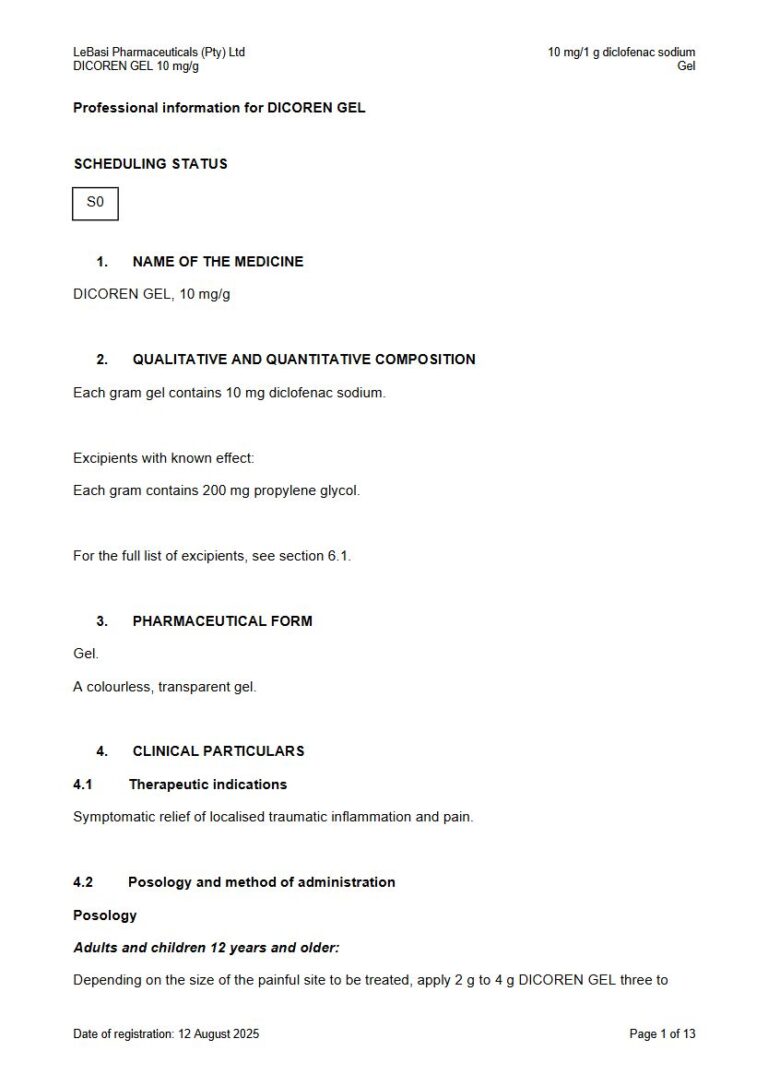
4.1 Therapeutic indications
Symptomatic relief of localised traumatic inflammation and pain.
4.2 Posology and method of administration
Posology
Adults and children 12 years and older: Depending on the size of the painful site to be treated, apply 2 g to 4 g DICOREN GEL three to four times daily to the affected parts and rub in gently. The duration of treatment will be determined by the indication and the response obtained. It is recommended that treatment be reviewed after 2 weeks. Patients should consult their doctor if the condition does not improve or worsens within 7 days of starting treatment.
Paediatric population
The safety and efficacy of DICOREN GEL in children under the age of 12 years have not been established.
Method of administration
For cutaneous use only. After application, the hands should be washed, unless they are the site being treated.
4.3 Contraindications
- Hypersensitivity to diclofenac sodium, acetylsalicylic acid or other nonsteroidal anti-inflammatory medicines. Hypersensitivity to any other ingredient of the gel.
- Patients with or without chronic asthma in whom attacks of asthma, urticaria or acute rhinitis are precipitated by aspirin or other nonsteroidal anti-inflammatory medicines.
- Concomitant use of other products containing diclofenac.
- Concomitant use of oral NSAIDs.
- DICOREN GEL should not be used by patients with porphyria.
- During the last trimester of pregnancy.
- Heart failure.
- History of gastrointestinal bleeding or perforation (PUBs) related to previous NSAIDs.
- Active or history of recurrent ulcer/haemorrhage/perforations.
- Patients with renal impairment.
4.4 Special warnings and precautions for use
The possibility of systemic adverse events from topical application of DICOREN GEL cannot be excluded if it is used on large areas of skin and over a prolonged period (see section 4.8). Serious skin reactions, some of them fatal, have been reported, including exfoliative dermatitis, Stevens-Johnson syndrome and toxic epidermal necrolysis, associated with the administration of nonsteroidal anti-inflammatory medicines (see section 4.8.). The risk of occurrence of these reactions is higher at the beginning of the treatment and in most cases these reactions manifested during the first month of treatment. Caution is required with concomitant use of oral nonsteroidal anti-inflammatory medicines, as the incidence of untoward effects, particularly systemic side effects, may increase. DICOREN GEL should be discontinued at the first signs of rash, mucosal injuries or other hypersensitivity manifestations. DICOREN GEL should be applied only to intact non-diseased skin, and not to skin wounds or open injuries. It should not be allowed to come into contact with the eyes or mucous membranes and should not be ingested. The area treated with DICOREN GEL should not be exposed to sunlight. DICOREN GEL can be used with non-occlusive bandages but should not be used with an airtight occlusive dressing. DICOREN GEL contains propylene glycol, which may cause skin irritation.
4.5 Interaction with other medicines and other forms of interaction
Diuretics, angiotensin-converting enzyme inhibitors (ACEI) and angiotensin II antagonists (AIIA): Nonsteroidal anti-inflammatory medicines may decrease the effectiveness of diuretics and other antihypertensive medicines. In some patients with impaired renal function (e.g. dehydrated patients or elderly patients with impaired renal function) the co-administration of an ACEI or AIIA and cyclooxygenase inhibitor may result in the progression of renal function deterioration, including the possibility of acute renal insufficiency, which is usually reversible. The occurrence of these interactions should be considered in patients applying DICOREN GEL in combination with an ACEI or AIIA, particularly if on large areas of the skin and for prolonged periods. Consequently, this combination should be used with caution, especially in elderly patients. Patients should be properly hydrated and the need to monitor the renal function after the beginning of the concomitant treatment and periodically thereafter should be considered.
Since systemic absorption of diclofenac sodium as in DICOREN GEL is very low, such interactions are very unlikely.
Lithium and digoxin: Diclofenac may increase plasma concentrations of lithium and digoxin.
Anticoagulants: Although clinical investigations do not appear to indicate that DICOREN GEL has an influence on the effect of anticoagulants, there are isolated reports of an increased risk of haemorrhage with the combined use of diclofenac and anticoagulant therapy. Therefore, to be certain that no change in anticoagulant dosage is required, close monitoring of such patients is required. As with other nonsteroidal anti-inflammatory medicines, diclofenac in a high dose can reversibly inhibit platelet aggregation.
Antidiabetic medicines: Clinical studies have shown that DICOREN GEL can be given together with oral antidiabetic medicines without influencing their clinical effect. However there have been isolated reports of hypoglycaemic and hyperglycaemic effects which have required adjustment to the dosage of hypoglycaemic medicines.
Ciclosporin: Cases of nephrotoxicity have been reported in patients receiving concomitant cyclosporin and NSAIDs, including diclofenac. This might be mediated through combined renal antiprostaglandin effects of both the NSAID and cyclosporin.
Methotrexate: Cases of serious toxicity have been reported when methotrexate and NSAIDs are given within 24 hours of each other. This interaction is mediated through accumulation of methotrexate resulting from impairment of renal excretion in the presence of the NSAID.
Quinolone antimicrobials: Convulsions may occur due to an interaction between quinolones and NSAIDs. This may occur in patients with or without a previous history of epilepsy or convulsions. Therefore, caution should be exercised when considering the use of a quinolone in patients who are already receiving an NSAID.
Other NSAIDs and steroids: Co-administration of DICOREN GEL with other systemic NSAIDs and steroids may increase the frequency of unwanted effects. Concomitant therapy with aspirin lowers the plasma levels of each, although no clinical significance is known.
Diuretics: Various NSAIDs are liable to inhibit the activity of diuretics. Concomitant treatment with potassium-sparing diuretics may be associated with increased serum potassium levels, hence serum potassium should be monitored.
Mifepristone: NSAIDs should not be used for 8-12 days after mifepristone administration as NSAIDs can reduce the effects of mifepristone.
Anti-hypertensives: Concomitant use of NSAIDs with antihypertensive medicines (i.e. beta-blockers, angiotensin converting enzyme (ACE) inhibitors, diuretics) may cause a decrease in their antihypertensive effect via inhibition of vasodilatory prostaglandin synthesis.
4.6 Fertility, pregnancy and lactation
Fertility: Treatment with DICOREN GEL is unlikely to have an adverse effect on fertility because the systemic exposure to diclofenac after application of DICOREN GEL is low.
Pregnancy: The systemic concentration of diclofenac is lower after topical administration, compared to oral formulations. With reference to experience from treatment with NSAIDs with systemic uptake, the following is recommended: Inhibition of prostaglandin synthesis may adversely affect the pregnancy and/or the embryo/foetal development. Data from epidemiological studies suggest an increased risk of miscarriage and of cardiac malformation and gastroschisis after use of a prostaglandin synthesis inhibitor in early pregnancy. The absolute risk for cardiovascular malformation was increased from less than 1 %, up to approximately 1,5 %. The risk is believed to increase with dose and duration of therapy. In animals, administration of a prostaglandin synthesis inhibitor has been shown to result in increased pre- and post-implantation loss and embryo-foetal lethality. In addition, increased incidences of various malformations, including cardiovascular, have been reported in animals given a prostaglandin synthesis inhibitor during the organogenetic period. During the first and second trimester of pregnancy, diclofenac should not be given unless clearly necessary. If diclofenac is used by a woman attempting to conceive, or during the first and second trimester of pregnancy, the dose should be kept as low and duration of treatment as short as possible. During the third trimester of pregnancy, all prostaglandin synthesis inhibitors may expose the foetus to:
- cardiopulmonary toxicity (with premature closure of the ductus arteriosus and pulmonary hypertension);
- renal dysfunction, which may progress to renal failure with oligohydramnios;
The mother and the neonate, at the end of pregnancy, to:
- possible prolongation of bleeding time, an anti-aggregating effect which may occur even at very low doses.
- inhibition of uterine contractions resulting in delayed or prolonged labour.
Consequently, diclofenac is contraindicated during the third trimester of pregnancy. Regular use of nonsteroidal anti-inflammatory medicines during the third trimester of pregnancy, may result in premature closure of the foetal ductus arteriosus in utero, and possibly, in persistent pulmonary hypertension of the new-born. The onset of labour may be delayed, and its duration increased.
Lactation: Diclofenac passes into breast milk in small amounts. However, at therapeutic doses of DICOREN GEL, no effects on the suckling child are anticipated. Because of a lack of controlled studies in lactating women, the product should only be used during lactation under advice from a health care provider. Under this circumstance, DICOREN GEL should not be applied on the breasts of nursing mothers, nor elsewhere on large areas of skin or for a prolonged period of time (see section 4.4).
4.7 Effects on ability to drive and use machines
Cutaneous application of DICOREN GEL has no or negligible influence on the ability to drive a vehicle and use machines.
4.8 Undesirable effects
Although less likely with the topical administration, some side effects normally associated with systemically administered diclofenac sodium, as in DICOREN GEL, may also occur. The prolonged use of DICOREN GEL in a relatively extensive area can cause systemic side effects such as nausea, vomiting, diarrhoea or epigastric pain.
Tabulated summary of adverse reactions
Infections and infestations
Less frequent: Pustular rash.
Immune system disorders
Less frequent: Hypersensitivity (including urticaria), anaphylactoid reactions (including shock and hypotension)*, angioedema (including face oedema)*, bullous reactions*, including toxic epidermal necrolysis* and Steven-Johnson*. syndrome*.
Respiratory, thoracic and mediastinal disorders
Less frequent: Asthma (including dyspnoea), pneumonitis*.
Skin and subcutaneous tissue disorders
Frequent: Rash and skin reactions*, eczema, erythema, dermatitis (including contact dermatitis), pruritus.
Less frequent: Bullous dermatitis, photosensitivity reaction.
Frequency unknown: Burning sensation at the application site, dry skin.
Blood and lymphatic system disorders
Less frequent: Leucopenia*, thrombocytopenia*, aplastic anaemia*, haemolytic anaemia*, agranulocytosis*.
Psychiatric disorders
Less frequent: Disorientation*, insomnia*, irritability*, depression*, nightmares*, psychotic reactions*.
Nervous system disorders
Frequent: Headache*, dizziness*, nervousness*.
Less frequent: Tiredness*, disturbances of sensation (including paraesthesia)*, memory disturbance*, convulsions*, anxiety*, tremor*, aseptic meningitis*, somnolence*, taste disturbances*, cerebrovascular accident*.
Eye disorders
Less frequent: Disturbances in vision (diplopia, blurred vision)*.
Ear and labyrinth disorders
Frequent: Vertigo*.
Less frequent: Impaired hearing, tinnitus*.
Cardiac disorders
Less frequent: Palpitation*, chest pain*, congestive heart failure*, oedema*, myocardial infarction*.
Vascular disorders
Less frequent: Vasculitis, hypertension*.
Gastrointestinal disorders
Frequent: Epigastric pain*, nausea*, vomiting*, diarrhoea*, abdominal cramps*, dyspepsia*, flatulence*, eructation*, anorexia*, local irritation*, abdominal pain*.
Less frequent: Gastrointestinal bleeding*, haematemesis*, melaena*, bloody diarrhoea*, peptic ulcer with or without bleeding* or perforation*, lower gut disorders such as non-specific haemorrhagic colitis*, exacerbation of ulcerative colitis* or Crohn's proctocolitis*, glossitis*, aphthous stomatitis*, oesophageal lesions*, diaphragm-like intestinal strictures*.
Hepatobiliary disorders
Frequent: Elevated transaminase levels (ALT, AST)*.
Less frequent: Hepatitis with or without jaundice*, fulminant hepatitis*, liver disorder*, hepatic necrosis*, hepatic failure*.
Renal and urinary disorders
Less frequent: Acute renal failure*, urinary abnormalities such as haematuria*, proteinuria*, interstitial nephritis*, nephritic syndrome*, papillary necrosis*.
* Reported for systemically absorbed diclofenac.
Reporting of suspected adverse reactions
Reporting suspected adverse reactions after authorisation of DICOREN GEL is important. It allows continued monitoring of the benefit/risk balance of the medicine. Health care providers are asked to report any suspected adverse reactions to the South African Health Products Regulatory Authority (SAHPRA) via the Med Safety APP (Medsafety X SAHPRA) and eReporting platform (who-umc.org) found on the SAHPRA website.
4.9 Overdose
Signs and symptoms
The low systemic absorption of DICOREN GEL renders overdose very unlikely. However, undesirable effects, similar to those observed following an overdose of diclofenac sodium tablets, can be expected if DICOREN GEL is inadvertently ingested.
Treatment
In the event of accidental ingestion resulting in significant systemic adverse effects, general therapeutic measures normally adopted to treat poisoning with nonsteroidal anti-inflammatory medicines should be used. The use of activated charcoal should be considered, especially within a short time (within one hour) of ingestion.
