
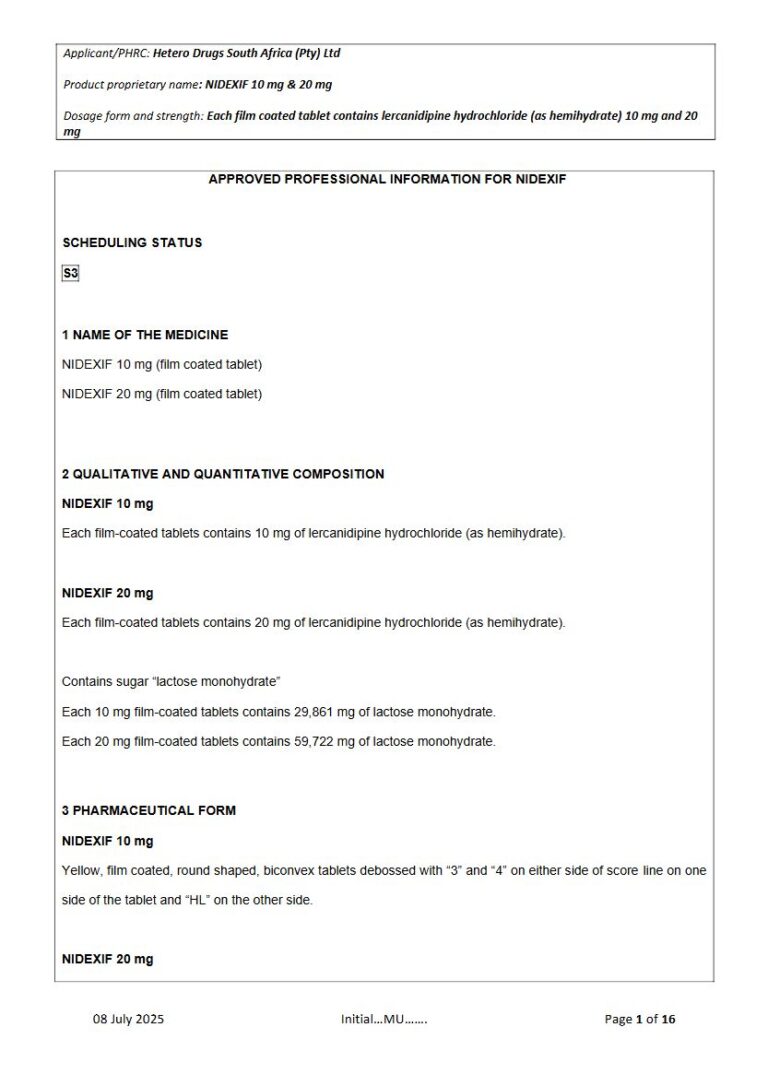
Nidexif 10 mg & 20 mg FC tablet
PDF Leaflet Revision Date: 08 July 2025
Clinical Summary
Quick overview from the medicine insert
Indication
Treatment of mild to moderate hypertension.
Dosage (summary)
Starting dose: 10 mg orally once daily before meals; may increase to 20 mg based on response.
Onset of Action / Duration
Onset: 2 weeks, Duration: 24 hours
Special Populations
- Elderly
- Renal impairment
- Hepatic impairment
Pregnancy & Breastfeeding
Not recommended during pregnancy or breastfeeding.
Key Drug Interactions
- CYP3A4 inhibitors
- Ciclosporin
- Grapefruit juice
- Inducers of CYP3A4
Contraindications
- Hypersensitivity to lercanidipine
- Left ventricular outflow tract obstruction
- Untreated congestive cardiac failure
- Unstable angina pectoris
- Severe hepatic impairment
- Severe renal impairment
- Co-administration with strong CYP3A4 inhibitors
Common side effects
- Headache
- Dizziness
- Tachycardia
- Flushing
- Hypotension
Counselling Points
- Take at least 15 minutes before meals.
- Avoid alcohol.
- Monitor blood pressure regularly.
Serious warnings
- Caution in sick sinus syndrome
- Increased cardiovascular risk in ischaemic heart disease
Important Disclaimer
The Nidexif 10 mg & 20 mg FC tablet professional information leaflet below is the property of Hetero Drugs South Africa and is provided on Medinsert exactly as issued, with no.. alterations or editorial changes. We make every effort to keep content current by updating documents as soon as new versions become available. Medinsert serves as a trusted access point for healthcare professionals, but does not replace official sources or clinical judgement. For more details, please read our full disclaimer. read more>>
 Healthcare Professionals Only
This content is for registered healthcare professionals
Sign in or create a free account to read the full package insert.
Free for HPCSA-registered professionals. Powered by Medinsert.
Clinical Particulars
Section 4 of the official insert — extracted exactly as issued, no alterations
4.1 Therapeutic indications
NIDEXIF is indicated for the treatment of mild to moderate hypertension.
4.2 Posology and method of administration
Posology
The recommended starting dosage is 10 mg orally once a day at least 15 minutes before a meal. In patients not responding adequately, the dose may be increased to 20 mg depending on the individual patientu2019s response. Dose titration should be gradual, because it may take about 2 weeks before the maximal antihypertensive effect is apparent.
Special populations
Use in the elderly
Although pharmacokinetic data and clinical experience suggest that no adjustment of the daily dosage is required, special care should be exercised when initiating treatment in the elderly.
Use in renal or hepatic dysfunction
Special care should be exercised when treatment is commenced in patients with renal or hepatic dysfunction. Although the recommended dosage schedule may be tolerated by these subgroups, an increase in dosage to 20 mg daily must be approached with caution. NIDEXIF is not recommended for use in patients with severe hepatic dysfunction or in patients with severe renal dysfunction (creatinine clearance < 10 mL/min).
Method of administration
Orally at least 15 minutes before a meal.
4.3 Contraindications
- Hypersensitivity to the lercanidipine hydrochloride, to any dihydropyridine or to any of the excipients listed in section 6.1.
- Left ventricular outflow tract obstruction.
- Untreated congestive cardiac failure.
- Unstable angina pectoris.
- Within 1 month of a myocardial infarction.
- Severe hepatic impairment.
- Severe renal impairment (GFR < 30 mL/min, including patients undergoing dialysis.
- Co-administration with:
- strong inhibitors of CYP3A4 (see section 4.5),
- cyclosporin (see section 4.5),
- grapefruit juice (see section 4.5).
- Pregnancy and lactation (see section 4.6).
- Women of child-bearing potential unless effective contraception is used.
4.4 Special warnings and precautions for use
Sick sinus syndrome
Lercanidipine should be administered with caution in patients with sick sinus syndrome (without a pacemaker).
Left ventricular dysfunction
Although hemodynamic controlled studies revealed no impairment of ventricular function, care is also required in patients with left ventricular dysfunction.
Ischaemic heart disease
It has been suggested that some short-acting dihydropyridines may be associated with increased cardiovascular risk in patients with ischaemic heart disease. Although lercanidipine is long-acting caution is required in such patients. Some dihydropyridines may rarely lead to precordial pain or angina pectoris. Very rarely patients with pre-existing angina pectoris may experience increased frequency, duration or severity of these attacks. Isolated cases of myocardial infarction may be observed (see section 4.8).
Use in renal or hepatic impairment
Special care should be exercised when treatment is commenced in patients with mild to moderate renal impairment. Although the usual recommended dose of 10 mg daily may be tolerated, an increase to 20 mg daily should be approached with caution. The antihypertensive effect may be enhanced in patients with moderate hepatic impairment and consequently an adjustment of the dosage should be considered. Lercanidipine is contraindicated in patients with severe hepatic impairment or renal impairment (GFR < 30 mL/min), including patients undergoing haemodialysis (see sections 4.2 and section 4.3).
Peritoneal Dialysis
Lercanidipine has been associated with the development of cloudy peritoneal effluent in patients on peritoneal dialysis. The turbidity is due to an increased triglyceride concentration in the peritoneal effluent. Whilst the mechanism is unknown, the turbidity tends to resolve soon after withdrawal of lercanidipine. This is an important association to recognise as cloudy peritoneal effluent can be mistaken for infective peritonitis with consequential unnecessary hospitalisation and empiric antibiotic administration.
Inducers of CYP3A4
Inducers of CYP3A4 like anticonvulsants (e.g. phenytoin, carbamazepine) and rifampicin may reduce lercanidipine plasma levels and therefore the efficacy of lercanidipine may be less than expected (see section 4.5).
Alcohol
Alcohol should be avoided since it may potentiate the effect of vasodilating antihypertensive medicines (see section 4.5).
Lactose
NIDEXIF contains lactose. Patients with rare hereditary problems of galactose intolerance, total lactase deficiency or glucose-galactose malabsorption should not take NIDEXIF.
Sodium
NIDEXIF contains less than 1 mmol sodium (23 mg) per tablet, that is to say essentially u201csodium - freeu201d.
Paediatric population
The safety and efficacy of lercanidipine have not been demonstrated in children.
4.5 Interaction with other medicines and other forms of Interaction
Contraindications of concomitant use
Inhibitors of CYP3A4
Lercanidipine is known to be metabolised by the CYP3A4 enzyme and therefore inhibitors of CYP3A4 administered concurrently may interact with the metabolism and elimination of lercanidipine. An interaction study with a strong CYP3A4 inhibitor, ketoconazole, has shown a considerable increase in plasma levels of lercanidipine (a 15-fold increase of the AUC and an 8-fold increase of the C max for the eutomer S- lercanidipine). Co-prescription of lercanidipine with inhibitors of CYP3A4 (e.g. ketoconazole, itraconazole, ritonavir, erythromycin, troleandomycin, clarithromycin) should be avoided (see section 4.3).
Ciclosporin
Increased plasma levels of both lercanidipine and ciclosporin have been observed following concomitant administration. A study in young healthy volunteers has shown that when ciclosporin was administered 3 hours after the lercanidipine intake, the plasma levels of lercanidipine did not change, while the AUC of ciclosporin increased by 27 %. However, the co-administration of lercanidipine with ciclosporin has caused a 3-fold increase of the plasma levels of lercanidipine and a 21% increase of the ciclosporin AUC. Ciclosporin and lercanidipine should not be administered together (see section 4.3).
Grapefruit or grapefruit juice
As for other dihydropyridines, lercanidipine is sensitive to inhibition of metabolism by grapefruit or grapefruit juice, with a consequent rise in its systemic availability and increased hypotensive effect. Lercanidipine should not be taken with grapefruit or grapefruit juice (see section 4.3).
Concomitant use not recommended
Inducers of CYP3A4
Co-administration of lercanidipine with CYP3A4 inducers like anticonvulsants (e.g. phenytoin, phenobarbitone, carbamazepine) and rifampicin should be approached with caution since the antihypertensive effect may be reduced, and blood pressure should be monitored more frequently than usual (see section 4.4).
Alcohol
Alcohol should be avoided since it may potentiate the effect of vasodilating antihypertensive medicines (see section 4.4).
Precautions including dose adjustment
Substrates of CYP3A4
Caution should be exercised when lercanidipine is co-prescribed with other substrates of CYP3A4, like terfenadine, astemizole, class III antiarrhythmic drugs such as amiodarone, quinidine, sotalol.
4.6 Fertility, pregnancy and lactation
Pregnancy
There is no clinical experience with NIDEXIF in pregnancy and lactation; NIDEXIF should therefore not be administered during pregnancy or to woman with child-bearing potential unless effective contraception is used.
Breastfeeding
Because of high lipophilicity of NIDEXIF, distribution in milk may be expected. NIDEXIF should therefore not be administered mothers who are breastfeeding their babies.
4.7 Effects on ability to drive and use machines
NIDEXIF has minor influence on the ability to drive and use machines. However, caution should be exercised because dizziness, asthenia, fatigue and rarely somnolence may occur.
4.8 Undesirable effects
Tabulated summary of adverse reactions
| SYSTEM ORGAN CLASS | FREQUENCY | ADVERSE REACTION |
|---|---|---|
| Immune system disorders | Less frequent | Hypersensitivity |
| Nervous system disorders | Frequent | Headache |
| Less frequent | Dizziness, somnolence, syncope, mental depression | |
| Eye disorders | Less frequent | Eye pain |
| Cardiac disorders | Frequent | Tachycardia, palpitations |
| Less frequent | angina pectoris, precordial pain, myocardial infarction, chest pain | |
| Vascular disorders | Less frequent | Flushing, hypotension, oedema peripheral |
| Gastrointestinal disorders | Less frequent | Dyspepsia, nausea, abdominal pain upper, vomiting, diarrhoea, gingival hypertrophy, peritoneal cloudy effluent |
| Hepatobiliary disorders | Less Frequent | Isolate and reversible serum transaminase increased |
| Skin and subcutaneous tissue disorders | Less Frequent | Rash, pruritus, urticaria, angioedema |
| Musculoskeletal and connective tissue disorders | Less Frequent | Myalgia |
| Renal and urinary disorders | Less Frequent | Polyuria, pollakiuria, increased micturition frequency |
| General disorders and administration site conditions | Less Frequent | Asthenia, fatigue, chest pain |
Lercanidipine does not appear to influence adversely blood sugar or serum lipid levels.
1 adverse reactions from spontaneous reporting in the worldwide post-marketing experience.
Reporting of suspected adverse reactions
Reporting suspected adverse reactions after authorisation of NIDEXIF is important. It allows continued monitoring of the benefit/risk balance of NIDEXIF. Healthcare providers are requested to report any suspected adverse drug reactions to SAHPRA via the Med Safety APP (Medsafety X SAHPRA) and eReporting platform (who-umc.org) found on SAHPRA website or to the Holder of certificate of registration through the mail: [email protected].
4.9 Overdose
Overdosage might be expected to cause excessive peripheral vasodilation with marked hypotension and reflex tachycardia. In case of severe hypotension, bradycardia and unconsciousness, cardiovascular support could be helpful, with intravenous atropine for bradycardia. In view of the prolonged pharmacological effect of lercanidipine, it is essential that the cardiovascular status of patients who take an overdose is monitored for at least 24 hours. Treatment is symptomatic and supportive.
