
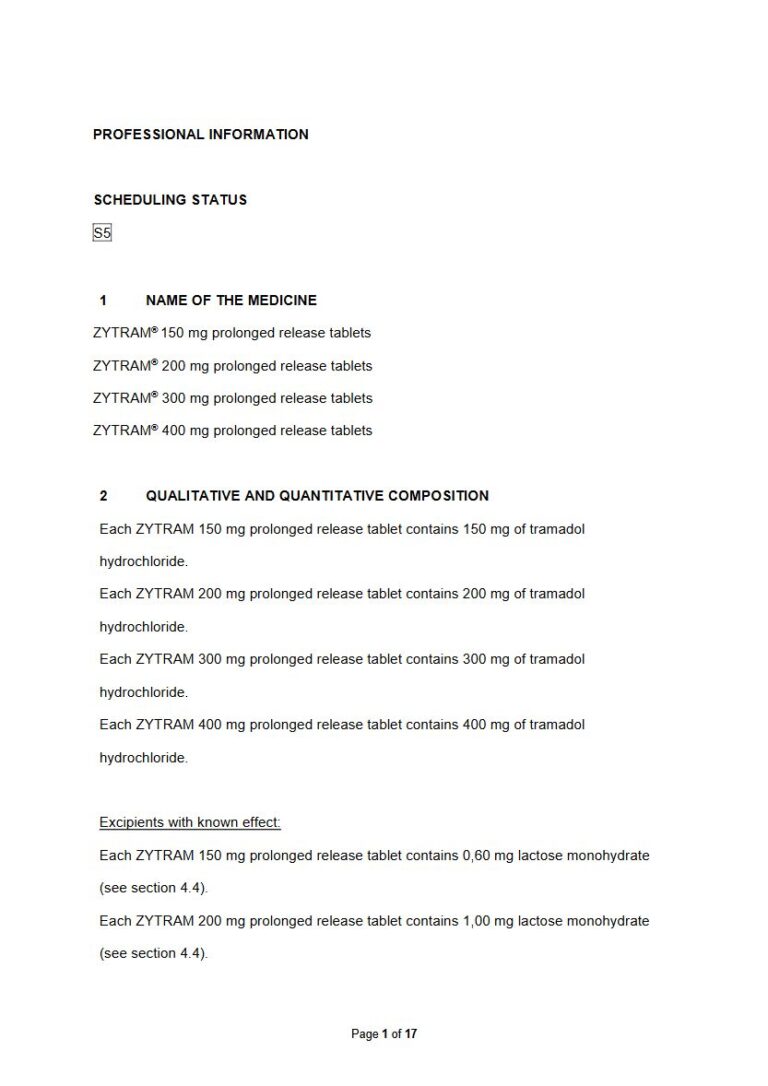
Zytram Tablet
PDF Leaflet Revision Date: 8 August 2023
Clinical Summary
Quick overview from the medicine insert
Indication
Treatment of moderate to severe pain.
Dosage (summary)
Initial dose: 150 mg daily; titrate as needed, max 400 mg/day.
Special Populations
- Elderly patients
- Renal impairment
- Hepatic impairment
Pregnancy & Breastfeeding
Not recommended during pregnancy or breastfeeding.
Key Drug Interactions
- MAO inhibitors
- CNS depressants
- SSRIs/SNRIs
Contraindications
- Hypersensitivity
- Acute intoxication with CNS depressants
- Postoperative pain management in children <18 years
Common side effects
- Nausea
- Dizziness
- Somnolence
- Constipation
Counselling Points
- Take whole, do not crush or chew
- Monitor for signs of dependence
- Avoid alcohol and CNS depressants
Serious warnings
- Risk of dependence and withdrawal symptoms
- Convulsions may occur
- Respiratory depression risk
Important Disclaimer
The Zytram Tablet professional information leaflet below is the property of Mundipharma and is provided on Medinsert exactly as issued, with no.. alterations or editorial changes. We make every effort to keep content current by updating documents as soon as new versions become available. Medinsert serves as a trusted access point for healthcare professionals, but does not replace official sources or clinical judgement. For more details, please read our full disclaimer. read more>>
 Healthcare Professionals Only
This content is for registered healthcare professionals
Sign in or create a free account to read the full package insert.
Free for HPCSA-registered professionals. Powered by Medinsert.
Clinical Particulars
Section 4 of the official insert — extracted exactly as issued, no alterations
4.1 Therapeutic indications
Treatment of moderate to severe pain. These tablets are indicated in adults and adolescents aged 12 years and above.
4.2 Posology and method of administration
Route of administration
Oral use
Posology
The dose should be adjusted to the intensity of the pain and the sensitivity of the individual patient. The lowest effective dose for analgesia should generally be selected. The correct dosage per individual patient is that which controls the pain, with no or tolerable side effects, for a full 24 hours. Patients transferring from immediate release tramadol preparations should have their total daily dose calculated, and start on the nearest dose in the ZYTRAM range. It is recommended that patients are slowly titrated to higher doses to minimise transient side effects. The need for continued treatment should be assessed at regular intervals as withdrawal symptoms and dependence have been reported (see section 4.4). A total daily dose of 400 mg should not be exceeded except in special clinical circumstances.
Adults and children over 12 years
The usual initial dose is one 150 mg tablet daily. If pain relief is not achieved, the dosage should be titrated upwards until pain relief is achieved.
Special populations
Elderly patients
A dose adjustment is not usually necessary in patients up to 75 years without clinically manifest hepatic or renal insufficiency. In elderly patients over 75 years elimination may be prolonged. Therefore, if necessary the dosage interval is to be extended according to the patient's requirements.
Renal impairment/dialysis
In patients with renal impairment the elimination of tramadol is delayed. In these patients, prolongation of the dosage intervals should be carefully considered according to the patient's requirements. As tramadol is only removed very slowly by haemodialysis or by haemofiltration, post-dialysis administration to maintain analgesia is not usually necessary.
Patients with hepatic impairment
In patients with hepatic insufficiency the elimination of tramadol hydrochloride is delayed. In these patients, prolongation of the dosage intervals should be carefully considered according to the patientu2019s requirements. In cases of severe hepatic insufficiency ZYTRAM tablets are not recommended.
Paediatric population
The safety and efficacy of ZYTRAM tablets has not been established and the product should not be used in children. On account of the high dosage strength, ZYTRAM tablets should not be used in children below the age of 12 years.
Duration of treatment
Under no circumstances should ZYTRAM tablets be given for longer than absolutely necessary. If the nature and severity of the disease require long-term pain treatment, careful checks should be carried out initially and at regular intervals to assess efficacy and adverse events and to what extent further treatment with ZYTRAM tablets is necessary.
Method of administration
ZYTRAM should be taken at 24-hourly intervals and must be swallowed whole and not broken, crushed or chewed.
4.3 Contraindications
ZYTRAM is contraindicated in:
u2022 hypersensitivity to the active substance or to any of the excipients listed in section 6.1;
u2022 acute intoxication with alcohol, hypnotics, centrally acting analgesics, opioids or psychotropic medicines;
u2022 patients who are receiving monoamine oxidase inhibitors or within two weeks of their withdrawal;
u2022 narcotic withdrawal treatment;
u2022 postoperative pain management in children younger than 18 years of age following tonsillectomy and/or adenoidectomy;
u2022 patients with epilepsy;
u2022 patients with increased intracranial pressure or central nervous depression due to head injury or cerebral disease;
u2022 pregnant and breastfeeding women (see section 4.6).
4.4 Special warnings and precautions for use
Tolerance, psychic and physical dependence may develop, especially after long-term use. When a patient no longer requires therapy with tramadol, it may be advisable to taper the dose gradually to prevent symptoms of withdrawal.
There is potential for abuse and development of psychological dependence to opioid analgesics, including tramadol, therefore the clinical need for continued analgesic treatment should be reviewed regularly. Treatment should be for short periods and under strict medical supervision. These tablets should be used with particular care in patients with a history of alcohol and drug abuse.
Tramadol is not suitable as a substitute in opioid-dependent patients. Although it is an opioid agonist, tramadol cannot suppress morphine withdrawal symptoms.
Convulsions have been reported at therapeutic doses and the risk may be increased at doses exceeding the usual upper daily dose limit. Patients with a history of epilepsy or those susceptible to seizures should only be treated with tramadol if there are compelling reasons. The risk of convulsions may increase in patients taking tramadol and concomitant medication that can lower the seizure threshold (see section 4.5). Tramadol should therefore be used with caution in patients prone to convulsive disorders.
Tramadol should be used with caution in patients with head injury, increased intracranial pressure, severe impairment of hepatic and renal function and in patients in shock.
Care should be taken when treating patients with respiratory depression, or if concomitant CNS depressant medicines (see section 4.5) are being administered, as the possibility of respiratory depression cannot be excluded in these situations. At therapeutic doses respiratory depression has infrequently been reported.
Opioid induced hyperalgesia
Opioid induced hyperalgesia (OIH) is a paradoxical response to an opioid in which there is an increase in pain perception despite stable or increased opioid exposure. It differs from tolerance, in which higher opioid doses are required to achieve the same analgesic effect or treat recurring pain (i.e. less focal), or pain from ordinary (i.e. ono-painful) stimuli (allodynia) with no evidence of disease progression. When OIH is suspected, the dose of opioid should be reduced or tapered off, if possible.
CYP2D6 metabolism
Tramadol is metabolised by the liver enzyme CYP2D6. If a patient has a deficiency or is completely lacking this enzyme an adequate analgesic effect may not be obtained. Estimates indicate that up to 7 % of the Caucasian population may have this deficiency. However, if the patient is an ultra-rapid metaboliser there is a risk of developing side effects of opioid toxicity even at commonly prescribed doses.
General symptoms of opioid toxicity include confusion, somnolence, shallow breathing, small pupils, nausea, vomiting, constipation and lack of appetite. In severe cases this may include symptoms of circulatory and respiratory depression, which may be life threatening and very rarely fatal. Estimates of prevalence of ultra-rapid metabolisers in different populations are summarised below:
Population Prevalence %
African/Ethiopian 29 %
African American 3,4 % to 6,5 %
Asian 1,2 % to 2 %
Caucasian 3,6 % to 6,5 %
Greek 6,0 %
Hungarian 1,9 %
Northern European 1 % to 2 %
Lactose
This medicinal product contains lactose. Patients with rare hereditary problems of galactose intolerance, the Lapp lactase deficiency or glucose-galactose malabsorption should not take this medicinal product.
Paediatric population
Post-operative use in children
There have been reports in the published literature that tramadol given post-operatively in children after tonsillectomy and/or adenoidectomy for obstructive sleep apnoea, led to rare, but life threatening adverse events. Extreme caution should be exercised when tramadol is administered to children for post-operative pain relief and should be accompanied by close monitoring for symptoms of opioid toxicity including respiratory depression.
Children with compromised respiratory function
Tramadol is not recommended for use in children in whom respiratory function might be compromised including neuromuscular disorders, severe cardiac or respiratory conditions, upper respiratory or lung infections, multiple trauma or extensive surgical procedures. These factors may worsen symptoms of opioid toxicity.
Hyponatraemia
Hyponatraemia has been reported with the use of ZYTRAM, usually in patients with predisposing risk factors, such as elderly patients and/or patients using concomitant medications that may cause hyponatraemia. This hyponatraemia appeared to be the result of the syndrome of inappropriate antidiuretic hormone secretion (SIADH) and resolved with discontinuation of ZYTRAM and appropriate treatment (e.g. fluid restriction). During ZYTRAM treatment, monitoring for signs and symptoms of hyponatraemia is recommended for patients with predisposing risk factors.
4.5 Interaction with other medicines and other forms of interaction
ZYTRAM should not be combined with MAO inhibitors, or used within 14 days of withdrawal of MAO inhibitors (see section 4.3).
In patients treated with MAO inhibitors in the 14 days prior to the use of the opioid pethidine, life-threatening interactions of the central nervous system, respiratory and cardiovascular function have been observed. The same interactions with MAO inhibitors cannot be ruled out during treatment with ZYTRAM.
Concurrent administration of tramadol with medicines that depress the CNS may lead to an increased risk of respiratory depression, profound sedation, coma and death. Medicines which depress the CNS include but are not limited to: other opioids (including antitussives and substitution therapy), anxiolytics, hypnotics and sedatives (including benzodiazepines), antipsychotics, antidepressants, phenothiazines, barbiturates and alcohol.
ZYTRAM can induce convulsions and increase the potential for selective serotonin re-uptake inhibitors (SSRIs), serotonin-norepinephrine reuptake inhibitors (SNRIs), tricyclic antidepressants, antipsychotics and other seizure threshold-lowering medicinal products (such as bupropion, mirtazapine, tetrahydrocannabinol) to cause convulsions.
Concomitant therapeutic use of ZYTRAM and serotonergic medicines, such as selective serotonin reuptake inhibitors (SSRIs), serotonin-norepinephrine reuptake inhibitors (SNRIs), MAO inhibitors (see section 4.3), tricyclic antidepressants and mirtazapine may cause serotonin toxicity. Serotonin syndrome is likely when one of the following is observed:
u2022 Spontaneous clonus
u2022 Inducible or ocular clonus with agitation or diaphoresis
u2022 Tremor and hyperreflexia
u2022 Hypertonia and body temperature > 38 u00baC and inducible or ocular clonus.
Withdrawal of the serotonergic medicines usually brings about a rapid improvement. Treatment depends on the type and severity of the symptoms.
Simultaneous treatment with carbamazepine may shorten the analgesic effect as a result of a reduction in serum levels of tramadol and its active metabolite.
Co-administration with cimetidine is associated with a small prolongation of the half-life of tramadol, but this is not clinically relevant.
Co-administered ritonavir may increase serum concentration of tramadol resulting in tramadol toxicity.
Digoxin toxicity has occurred rarely during co-administration of digoxin and tramadol.
Mixed agonists/antagonists (e.g. buprenorphine, nalbuphine, pentazocine): The analgesic effect of tramadol which is a pure agonist may be reduced, and a withdrawal syndrome may occur.
Caution should be exercised during concomitant treatment with ZYTRAM and warfarin-like medicines due to reports of increased International Normalised Ration (INR) with major bleeding and ecchymoses in some patients.
The analgesic effect of tramadol is in part mediated by inhibition of the re-uptake of noradrenaline (norepinephrine) and enhancement of the release of serotonin (5-HT). In studies the pre- or postoperative application of the antiemetic 5-HT3 antagonist ondansetron increased the requirements of tramadol in patients with postoperative pain.
4.6 Fertility, pregnancy and lactation
Pregnancy
Safety during pregnancy and lactation has not been established. Animal studies have shown effects on organ development, ossification and neonatal mortality (see section 5.3). Tramadol crosses the placental barrier and chronic use during pregnancy can cause withdrawal symptoms in the new-born baby. Therefore, ZYTRAM should not be used during pregnancy.
Tramadol administered before or during birth does not affect uterine contractility. In neonates it may induce changes in respiratory rate which are not usually clinically relevant.
Breastfeeding
Tramadol is excreted in breast milk. Tramadol should not be used during breastfeeding.
4.7 Effects on ability to drive and use machines
Tramadol may cause drowsiness, blurred vision and dizziness which may be enhanced by alcohol or other CNS depressants. If affected, the patient should not drive or operate machinery.
4.8 Undesirable effects
a. Summary of the safety profile
In clinical studies, the most common adverse events observed with ZYTRAM were those typical of opioids and mainly concerned the gastrointestinal and nervous system. In addition, adverse effects concerning the skin were noted. Adverse effects affecting the gastrointestinal system included nausea, vomiting, constipation, dry mouth, dyspepsia, and abdominal pain. Adverse effects affecting the nervous system included drowsiness, dizziness, insomnia, confusion, sedation, somnolence, headache, fatigue, and paraesthesia. Adverse effects affecting the skin included pruritus and flushing. In the studies in patients taking ZYTRAM these adverse reactions were in general of mild to moderate severity and partly decreased in incidence during use.
b. Tabulated list of adverse reactions
The reactions are listed as MedDRA preferred term by system organ class and absolute frequency. Very common (u2265 1/10); common (u2265 1/100 to < 1/10); uncommon (u2265 1/1 000 to < 1/100); rare (u2265 1/10 000 to < 1/1 000); very rare (< 1/10 000); not known (cannot be estimated from the available data).
Immune System disorders
Rare Hypersensitivity, Anaphylactic and anaphylactoid responses
Metabolism and nutrition disorders
Rare Decreased appetite
Not known Hypoglycaemia
Psychiatric disorders
Uncommon Medicine dependence
Rare Hallucinations, Nightmare, Mood altered, Euphoric mood, Dysphoria, Decreased activity, Illusion, Confusional state
Nervous system disorders
Very Common Dizziness
Common Somnolence
Uncommon Headache
Rare Paraesthesia, Psychomotor hyperactivity, Cognitive disorder, Sensory disturbance, Judgement impaired, Seizure
Eye disorders
Rare Blurred vision
Cardiac disorders
Uncommon Palpitations, Tachycardia
Rare Bradycardia
Vascular disorders
Uncommon Orthostatic hypotension, Hypotension, Circulatory collapse
Rare Hypertension, Flushing
Respiratory, thoracic and mediastinal disorders
Rare Dyspnoea, Worsening of asthma, Respiratory depression, Bronchospasm, Wheezing
Gastrointestinal disorders
Very common Nausea
Common Vomiting, Dry mouth
Uncommon Retching, Constipation, Abdominal discomfort
Rare Diarrhoea
Hepatobiliary disorders
Very Rare Hepatic enzyme increased
Skin and subcutaneous tissue disorders
Common Hyperhidrosis
Uncommon Pruritus, Rash, Urticaria
Rare Angioedema
Musculoskeletal and connective tissue disorders
Rare Muscular weakness
Renal and urinary disorders
Rare Micturition disorder, Dysuria, Urinary retention
General disorders and administration site conditions
Very Rare Medicine withdrawal syndrome which may include: agitation, anxiety, nervousness, insomnia, hyperkinesia, tremor, gastrointestinal symptoms
Not known Asthenia
c. Description of selected adverse reactions
Tolerance, psychic and physical dependence may develop, especially after long-term use. When a patient no longer requires therapy with tramadol, it may be advisable to taper the dose gradually to prevent symptoms of withdrawal (see section 4.2).
d. Paediatric population
Neonatal drug withdrawal syndrome may occur in infants born to mothers taking tramadol, however the frequency is unknown (see section 4.6).
As these tablets are made using an insoluble matrix from which the active ingredient is gradually released, the patient may notice the matrix in their faeces.
Reporting of suspected adverse reactions
Reporting suspected adverse reactions after authorisation of the medicine is important. It allows continued monitoring of the benefit/risk balance of the medicine. Healthcare providers are asked to report any suspected adverse reactions to SAHPRA via the u201c6.04 Adverse Drug Reactions Reporting Formu201d, found online under SAHPRAu2019s publications: https://www.sahpra.org.za/Publications/Index/8 , or you can report directly to the company at [email protected].
4.9 Overdose
Symptoms
Symptoms of overdosage are typical of other opioid analgesics, and include miosis, vomiting, circulatory collapse, sedation and coma, seizures and respiratory depression. In severe cases tramadol overdose may result in a fatal outcome.
Management
The general emergency measures apply. Keep open the airway, prevent aspiration and maintain respiration and circulation depending on the symptoms. Suitable measures should be taken to avoid aspiration dangers. The pure opioid antagonists such as naloxone are specific antidotes against symptoms from opioid overdose induced by tramadol, though it will not antagonise tramadolu2019s inhibitory effects on MAO reuptake or serotonin releasing effects. Other supportive measures should be employed as needed. Naloxone should be used to reverse respiratory depression; fits can be controlled with diazepam. In case of oral intake of overdose, consider activated charcoal if the patient presents within one hour of ingestion of tramadol, provided the patient's airway can be protected.
Although it may seem reasonable to assume that later administration of activated charcoal may be beneficial for prolonged-release preparations and medicines that slow gastric emptying, there is no clinical trial evidence to support this.
Tramadol is minimally eliminated from the serum by haemodialysis or haemofiltration. Therefore, treatment of acute intoxication with tramadol with haemodialysis or haemofiltration alone is not suitable for detoxification.
