
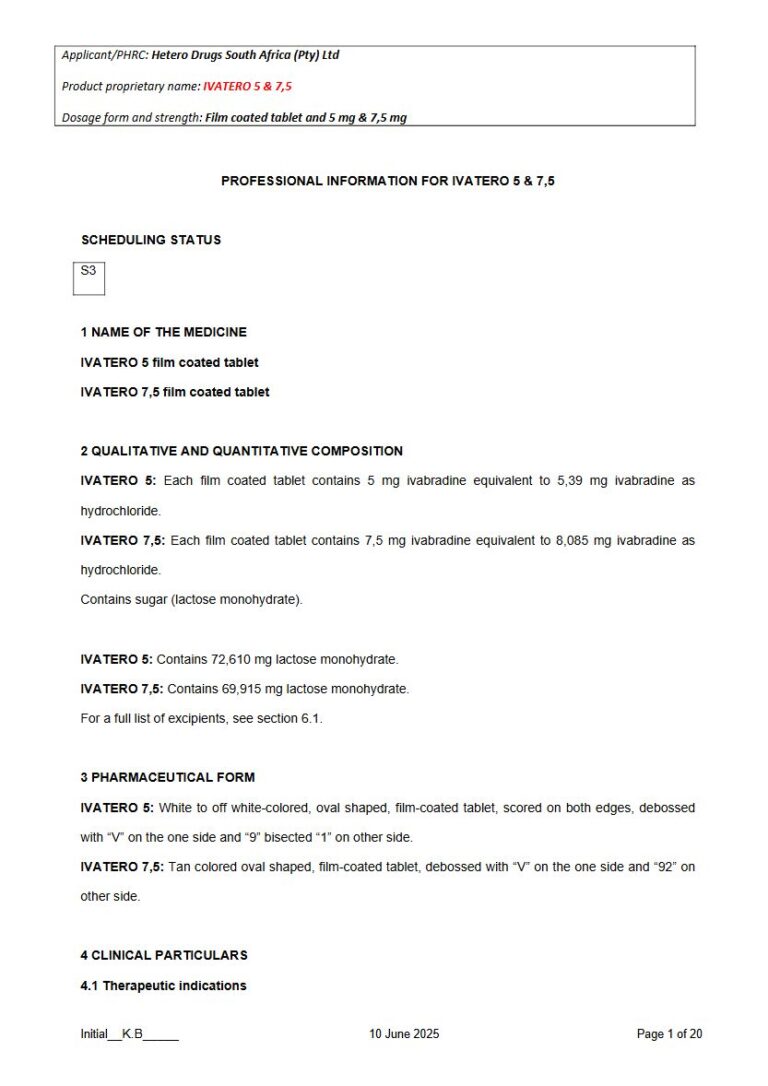
Ivatero 5 mg /7,5 mg FC tablet
PDF Leaflet Revision Date: 10 June 2025
Clinical Summary
Quick overview from the medicine insert
Indication
Symptomatic treatment of chronic stable angina pectoris and chronic heart failure.
Dosage (summary)
5 mg twice daily, may increase to 7.5 mg if tolerated.
Special Populations
- Elderly
- Renal impairment
- Hepatic impairment
Pregnancy & Breastfeeding
Contraindicated in pregnancy and lactation due to teratogenic effects.
Key Drug Interactions
- Strong CYP3A4 inhibitors
- Moderate CYP3A4 inhibitors
- QT-prolonging medicines
Contraindications
- Severe hypotension
- 3rd degree AV block
- Pacemaker dependence
- Resting heart rate < 70 bpm
Common side effects
- Bradycardia
- Phosphenes
- Headache
- Dizziness
Counselling Points
- Take with food
- Monitor for visual disturbances
- Report symptoms of bradycardia
Serious warnings
- Risk of atrial fibrillation
- Monitor heart rate
- Discontinue if no improvement in angina
Important Disclaimer
The Ivatero 5 mg /7,5 mg FC tablet professional information leaflet below is the property of Hetero Drugs South Africa and is provided on Medinsert exactly as issued, with no.. alterations or editorial changes. We make every effort to keep content current by updating documents as soon as new versions become available. Medinsert serves as a trusted access point for healthcare professionals, but does not replace official sources or clinical judgement. For more details, please read our full disclaimer. read more>>
 Healthcare Professionals Only
This content is for registered healthcare professionals
Sign in or create a free account to read the full package insert.
Free for HPCSA-registered professionals. Powered by Medinsert.
Clinical Particulars
Section 4 of the official insert — extracted exactly as issued, no alterations
4.1 Therapeutic indications
Symptomatic treatment of chronic stable angina pectoris: IVATERO is indicated for the symptomatic treatment of chronic stable angina pectoris, in patients with normal sinus rhythm and heart rate u2265 70 bpm, as monotherapy or in combination with beta-blockers.
Treatment of chronic heart failure: IVATERO is indicated in adults in sinus rhythm with mild to moderate (NYHA II & III class) symptomatic heart failure whose heart rate is u2265 77 bpm to reduce cardiovascular events (cardiovascular mortality or hospitalisation for worsening heart failure), in combination with standard therapy including beta-blockers or when beta-blockers are contraindicated or not tolerated.
4.2 Posology and method of administration
Posology
Symptomatic treatment of chronic stable angina pectoris: It is recommended that the decision to initiate or titrate treatment takes place using serial heart rate measurements, ECG or ambulatory 24-hour monitoring. The starting dose of IVATERO in patients below 75 years of age should not exceed 5 mg twice daily. After two to four weeks of treatment, if the patient is still symptomatic, if the initial dose is well tolerated and if resting heart rate remains above 60 bpm, the dose may be increased to a maximum of 7,5 mg twice daily depending on the therapeutic response. If there is no improvement in symptoms of angina within 3 months after start of treatment, treatment of IVATERO should be discontinued (see section 4.4). In addition, discontinuation of treatment should be considered if there is only limited symptomatic response and when there is no clinically relevant reduction in resting heart rate within three months. If, during treatment, heart rate decreases below 50 bpm at rest or the patient experiences symptoms related to bradycardia, such as dizziness, fatigue or hypotension, the dosage must be titrated downward including the lowest dose of 2,5 mg twice daily (one half 5 mg tablet twice daily). After dose reduction, heart rate should be monitored (see section 4.4). Treatment must be discontinued if the heart rate remains below 50 bpm or symptoms of bradycardia persist, despite dose reduction.
Treatment of chronic heart failure: The recommended starting dose of ivabradine is 5 mg twice daily in patients below 75 years of age. After two weeks of treatment, the dose can be increased to a maximum of 7,5 mg twice daily, if resting heart rate is persistently above 60 bpm or decreased to 2,5 mg twice daily (one half 5 mg tablet twice daily) if resting heart rate is persistently below 50 bpm, or in case of symptoms related to bradycardia such as dizziness, fatigue or hypotension. If heart rate is between 50 and 60 bpm, the dose of 5 mg twice daily should be maintained. If during treatment, the heart rate decreases persistently to below 50 beats per minute (bpm) at rest or the patient experiences symptoms related to bradycardia, the dose must be titrated downward to the next lower dose in patients receiving 7,5 mg twice daily or 5 mg twice daily. If the heart rate increases persistently to above 60 beats per minute at rest, the dose can be up titrated to the next higher dose in patients receiving 2,5 mg twice daily or 5 mg twice daily. Treatment must be discontinued if heart rate remains below 50 bpm or symptoms of bradycardia persist (see section 4.4).
Special populations
Elderly patients: In patients aged 75 years or more, a lower starting dose should be considered. (2,5 mg twice daily i.e. one half 5 mg tablet twice daily) before up-titration if necessary.
Patients with renal impairment: No dose adjustment is required in patients with renal insufficiency and creatinine clearance above 15 ml/min (see section 5). No data are available in patients with creatinine clearance below 15 ml/min. IVATERO should therefore be used with precaution in this population.
Patients with hepatic impairment: No dose adjustment is required in patients with mild hepatic impairment. IVATERO is not recommended in patients with moderate hepatic insufficiency, since there is limited data and is contraindicated for use in patients with severe hepatic insufficiency, since it has not been studied in this population (see section 4.3).
Paediatric population: The safety and efficacy of IVATERO in children aged below 18 years have not yet been established.
Method of administration
IVATERO tablets must be taken orally twice daily, i.e. once in the morning and once in the evening. IVATERO tablets should be taken with food.
4.3 Contraindications
Pregnancy and lactation, as IVATERO has shown to be teratogenic in animal reproductive studies (see section 4.6).
- Known hypersensitivity to ivabradine or to any of the excipients of IVATERO (see section 6.1).
- 3rd degree atrioventricular (AV) Block.
- Pacemaker dependent (heart rate imposed exclusively by the pacemaker).
- Resting heart rate below 70 bpm prior to treatment.
- Severe hypotension (< 90/50 mmHg).
- Cardiogenic shock.
- Unstable or acute heart failure.
- Acute coronary syndrome.
- Unstable angina pectoris.
- Use in patients with congenital long QT syndrome or in patients treated with QT-prolonging medicines should be avoided (see section 4.4).
- In combination with strong cytochrome P450 inhibitors such as azole antifungals, macrolide antibiotics, HIV protease inhibitors (see section 4.5).
- Concomitant use of St Johnu2019s Wort.
- IVATERO is not recommended in patients with moderate liver dysfunction (limited data in these populations) and is contraindicated in severe liver dysfunction (no data).
- Combination with verapamil or diltiazem, which are moderate CYP3A4 inhibitors with heart-rate reducing properties (see section 4.5).
- Women of childbearing potential not using appropriate contraceptive measures (see section 4.6).
- Concomitant use of grapefruit juice is not recommended (see section 4.5).
- Concomitant use with QT-prolonging medicines: The concomitant use of cardiovascular (quinidine, disopyramide, bepridil, sotalol, ibutilide, amiodarone) or non-cardiovascular (tricyclic antidepressant, antipsychotics, erythromycin IV, pentamidine, pimozide, mefloquine) QT-prolonging medicines with IVATERO should be avoided since QT-prolongation may be exacerbated by heart rate reduction.
- IVATERO has not been studied in patients with rapid conduction disorders i.e. WPW.
- Cardiac dysrhythmias: sick sinus syndrome, sino-atrial block.
- Stroke: The use of IVATERO is not recommended immediately after a stroke since no data are available in these situations.
- Use in patients with AV-block of 2nd degree: IVATERO is not recommended in patients with AV-block of 2nd degree.
- Acute myocardial infarction.
4.4 Special warnings and precautions for use
IVATERO treatment should be discontinued if the symptoms of angina pectoris do not improve with 3 months of IVATERO treatment. Lack of benefit on clinical outcomes in patients with symptomatic chronic stable angina pectoris: IVATERO is indicated only for symptomatic treatment of chronic stable angina pectoris, because IVATERO has no benefits on cardiovascular outcomes (e.g. myocardial infarction or cardiovascular death).
Measurement of heart rate: Given that the heart rate may fluctuate considerably over time, serial heart rate measurements, ECG or ambulatory 24-hour monitoring is recommended when determining resting heart rate before initiation of IVATERO treatment and in patients on treatment with IVATERO when titration is considered. This also applies to patients who develop a low heart rate on treatment with IVATERO, in particular when heart rate decreases below 50 bpm, or after dose reduction (see section 4.2).
Chronic heart failure: Heart failure must be stable before considering ivabradine treatment. Use in patients with a low heart rate: IVATERO must not be initiated in patients with a pre-treatment resting heart rate below 70 beats per minute (see section 4.3). If, during IVATERO treatment, heart rate decreases below 50 bpm at rest or the patient experiences symptoms related to bradycardia, the dose must be titrated downward or discontinued. Treatment must be discontinued if heart rate below 50 bpm persists (see section 4.2).
Combination with other anti-angina medications: Concomitant use of IVATERO with heart rate reducing calcium channel blockers such as verapamil or diltiazem is contraindicated (see sections 4.3 and 4.5). Additional efficacy of IVATERO in combination with dihydropyridine calcium channel blockers has not been established.
Use in patients with congenital QT syndrome or in patients treated with QT-prolongation medicines: Since IVATERO reduces heart rate it should be avoided in patients with congenital QT syndrome or treated with QT-prolongations medicines. If the combination appears necessary, close cardiac monitoring is needed.
Heart rate reduction, as caused by IVATERO, may exacerbate QT-prolongation, which may give rise to severe dysrhythmias, in particular Torsade de pointes.
Cardiac dysrhythmias: IVATERO is not effective in the treatment or prevention of cardiac dysrhythmias and likely loses its efficacy when a tachy-dysrhythmia occurs (i.e. ventricular or supra-ventricular tachycardia). IVATERO is not recommended in patients with atrial fibrillation or with other cardiac dysrhythmias that interfere with sinus node function. In patients treated with IVATERO the risk of developing atrial fibrillation is increased (see section 4.8). Atrial fibrillation has been more common in patients concomitantly using amiodarone or potent class I anti-dysrhythmics. It is recommended to regularly clinically monitor IVATERO treated patients for the occurrence of atrial fibrillation (sustained of paroxysmal), which should also include ECG monitoring if clinically indicated (i.e. in case of exacerbated angina, palpitations or irregular pulse). Patients should be informed of signs and symptoms of atrial fibrillation and be advised to contact their medical practitioner if these occur. If atrial fibrillation develops during treatment, the balance of benefits and risks of continued IVATERO treatment should be carefully reconsidered. Chronic heart failure patients with intraventricular conductions defects (bundle branch block left, bundle branch block right) and ventricular dyssynchrony should be closely monitored.
Visual function: Ivabradine influences on retinal function. To date, there is no evidence of a toxic effect of ivabradine on the retina, but the effects of long-term ivabradine treatment beyond one year on retinal function are currently not known. Cessation of treatment should be considered if any unexpected deterioration in visual function occurs. Caution should be exercised in patients with retinitis pigmentosa.
Wolf-Parkinson-White-syndrome: IVATERO has not been studied in patients with Wolf-Parkinson-White-syndrome (see section 4.3).
Moderate to severe liver dysfunction: IVATERO is not recommended in patients with moderate liver dysfunction since there is limited data in these populations and is contraindicated in severe liver dysfunction (see section 4.3).
Aortic and/or Mitral valvular disease: Due to the lack of data, IVATERO is not recommended in patients with severe aortic and/or mitral valvular disease.
Stroke: The use of ivabradine is not recommended immediately after a stroke since no data is available in these situations.
Concomitant use with cytochrome P450 3A4 (CYP3A4) inhibitors or inducers: Strong CYP3A4 inhibitors: As these medicines significantly increase IVATERO plasma concentrations, their concomitant use with IVATERO is contraindicated (see section 4.3). Moderate CYP3A4 inhibitors: As these medicines increase ivabradine plasma concentrations, their concomitant use with IVATERO may require a downward titration of the dose of IVATERO depending on heartrate (see section 4.5). CYP3A4 inducers: As these medicines decrease ivabradine plasma concentrations, their prolonged concomitant use with IVATERO may require an upward titration of the dose of IVATERO depending on the therapeutic response. In this case, heart rate monitoring is recommended when discontinuing CYP3A4 inducers (see section 4.5).
Hypertension requiring blood pressure treatment modifications: As patients treated with IVATERO may experience episodes of increased blood pressure, blood pressure should be monitored at appropriate intervals (see section 4.8).
Patients with hypotension: Limited data are available in patients with mild to moderate hypotension, and IVATERO should therefore be used with caution in these patients. IVATERO is contraindicated in patients with severe hypotension (blood pressure < 90/50 mmHg) (see section 4.3).
Lactose warning: IVATERO contains lactose. Patients with rare hereditary problems of galactose intolerance, total lactase deficiency or glucose-galactose malabsorption should not take this medicine.
4.5 Interaction with other medicine and other forms of interaction
Pharmacokinetic interactions: Cytochrome P450 3A4 (CYP3A4): Ivabradine is metabolised by cytochrome P450 3A4 (CYP3A4) and is a weak inhibitor of this cytochrome. Therefore, ivabradine is unlikely to influence the metabolism and plasma concentrations of other CYP3A4 substrates. CYP3A4 inhibitors and inducers are liable to interact with ivabradine and to influence its metabolism and pharmacokinetics. Drug-drug interaction studies have established that CYP3A4 inhibitors increase ivabradine plasma concentrations, while inducers decrease them. Increased plasma concentrations of ivabradine may be associated with excessive bradycardia (see section 4.3).
Concomitant use contraindicated: The concomitant use of potent CYP3A4 inhibitors such as azole antifungals (ketoconazole, itraconazole), macrolide antibiotics (clarithromycin, erythromycin taken orally, josmycin, telithromycin), HIV protease inhibitors (including nelfinavir, ritonavir) is contraindicated (see section 4.3). The potent CYP3A4 inhibitors ketoconazole (200 mg once daily) and josamycin (1 g twice daily) increased the mean plasma exposure of ivabradine by 7 to 8 fold.
Moderate CYP3A4 inhibitors: Specific interaction studies in healthy volunteers and patients have shown that the combination of ivabradine with diltiazem and verapamil resulted in an increased ivabradine exposure (2 to 3 fold increase in AUC) with an additional heart rate reduction of 5 bpm. The concomitant use of ivabradine with these medicines is contraindicated (see section 4.3).
Concomitant use not recommended: Grapefruit juice: Ivabradine exposure was increased by 2-fold following the co-administration with grapefruit juice. Therefore the intake of grapefruit juice should be avoided.
Concomitant use with caution: The concomitant use of IVATERO with other moderate CYP3A4 inhibitors (i.e. fluconazole) may be considered at the starting dose of 2,5 mg twice daily and if resting heart rate is above 70 bpm, while monitoring heart rate. CYP3A4 metabolism inducers such as rifampicin, barbiturates, phenytoin and Hypericum perforatum (St Johnu2019s Wort): Prolonged concomitant use of these medicines with ivabradine may decrease ivabradine exposure and activity and therefore require an upward titration of the dose of IVATERO. The combination of IVATERO 10 mg twice daily with St Johnu2019s Wort was shown to reduce the area under the curve (AUC) of ivabradine by 50 %. The intake of St Johnu2019s Wort is not recommended (see section 4.3).
Other concomitant use: Specific interaction studies have shown no clinically significant pharmacokinetic or pharmacodynamic interactions between IVATERO and any of the following: digoxin, HMG CoA reductase inhibitors (statins), proton pump inhibitors (e.g. omeprazole, lansoprazole), dihydropyridine calcium channel blockers (nifedipine, amlodipine, lacidipine), aspirin and warfarin. In pivotal phase III clinical trials the following medicines were frequently combined with ivabradine with no evidence of safety concerns: angiotensin converting enzyme inhibitors, angiotensin II antagonists, beta-blockers, diuretics, anti-aldosterone, calcium channel blockers (e.g. nifidipine), short and long acting nitrates, HMG CoA reductase inhibitors, fibrates, proton pump inhibitors, oral antidiabetics (including: biguanides, sulphonylureas, alpha-glucosidases inhibitors, DPP-4 inhibitors, glitazones (thiazolidinediones), aspirin and other anti-platelet medicines.
Pharmacodynamic interactions: Concomitant use not recommended: QT-prolonging medicines: u2022 Cardiovascular QT-prolonging medicines (e.g. quinidine, disopyramide, bepridil, sotalol, ibutilide, amiodarone). u2022 Non cardiovascular QT-prolonging medicines (e.g. pimozide, ziprasidone, sertindole, mefloquine, halofantrine, pentamidine, cisapride, intravenous erythromycin). The concomitant use of cardiovascular and non-cardiovascular QT-prolonging medicines with IVATERO should be avoided since QT-prolongation may be exacerbated by heart rate reduction. If the combination appears necessary, close cardiac monitoring is required.
Concomitant use with precaution: Potassium-depleting diuretics (thiazide diuretics and loop diuretics): Hypokalaemia can increase the risk of dysrhythmia. As IVATERO may cause bradycardia, the resulting combination of hypokalaemia and bradycardia is a predisposing factor to the onset of severe dysrhythmias, especially in patients with long QT syndrome, whether congenital or substance induced (see section 4.3).
Paediatric population: Interaction studies have only been performed in adults.
4.6 Fertility, pregnancy and lactation
Women of childbearing potential: Women of childbearing potential should use appropriate contraceptive measures during treatment (see section 4.3).
Pregnancy: Animal reproduction studies have shown embryotoxic and teratogenic effects at doses similar to those used in humans.
Lactation: Animal studies indicate that ivabradine is excreted in milk. Therefore, IVATERO is contraindicated during pregnancy and lactation (see section 4.3).
4.7 Effects on ability to drive and use machines
IVATERO may cause transient visual symptoms consisting mainly of phosphenes. The possible occurrence of such visual symptoms should be taken into account when driving or using machines in situations where sudden variations in light intensity may occur. IVATERO may also cause headache, generally during the first month of treatment, and dizziness, possibly related to bradycardia (see section 4.8).
4.8 Undesirable effects
a) Summary of the safety profile: Ivabradine has been studied in clinical trials involving nearly 45 000 patients. The frequent adverse events with IVATERO, luminous phenomena (phosphenes) and bradycardia, are dose dependant and are related to the pharmacological effect of the medicine.
b) Tabulated summary of adverse reactions
Blood and lymphatic system disorders: Less frequent: Eosinophilia
Metabolism and nutrition disorders: Less frequent: Hyperuricaemia
Nervous system disorders: Frequent: Headache, generally during the first month of treatment, dizziness, possibly related to bradycardia. Less frequent: Syncope, possibly related to bradycardia.
Eye disorders: Frequent: Luminous phenomena (phosphenes), blurred vision. Less Frequent: Visual impairment, diplopia.
Ear and labyrinth disorders: Less frequent: Vertigo.
Cardiac disorders: Frequent: Bradycardia, AV 1st degree block (ECG prolonged PQ interval), atrial fibrillation, ventricular extrasystoles. Less frequent: Palpitations, supraventricular extrasystoles, AV 2nd degree block, AV 3rd degree block, sick sinus syndrome.
Vascular disorders: Frequent: Increased blood pressure. Frequency unknown: Hypotension, possibly related to bradycardia.
Respiratory, thoracic and mediastinal disorders: Less frequent: Dyspnoea.
Gastrointestinal disorders: Less frequent: Nausea, constipation, diarrhoea. Frequency unknown: Abdominal pain.
Skin and subcutaneous tissue disorders: Less Frequent: Angioedema, rash, erythema, pruritus, urticaria.
Musculoskeletal and connective tissue disorders: Less frequent: Muscle cramps.
General disorders and administration site conditions: Less Frequent: Asthenia, possibly related to bradycardia, fatigue, possibly related to bradycardia, malaise, possibly related to bradycardia.
Investigations: Less frequent: Elevated creatinine in blood, ECG prolonged QT interval.
c) Description of selected adverse reactions: Luminous phenomena (phosphenes) were reported by 14,5 % of patients, described as a transient enhanced brightness in a limited area of the visual field. They are usually triggered by sudden variations in light intensity. Phosphenes may also be described as a halo, image decomposition (stroboscopic and kaleidoscopic), coloured bright lights, or multiple images (retinal persistency). The onset of phosphenes is generally within the first two months of treatment after which they may occur repeatedly. Phosphenes were generally reported to be of mild to moderate intensity. All phosphenes resolved during or after treatment, of which a majority resolved during treatment. Less than 1 % of patients changed their daily routine or discontinued the treatment in relation with phosphenes. Bradycardia was reported by patients particularly within the first 2 to 3 months of treatment initiation and patients experienced a severe bradycardia below or equal to 40 bpm. In patients with angina pectoris, atrial fibrillation developed in about 5 % of patients treated with ivabradine.
In a pooled analysis of all the Phase II/III double blind controlled clinical trials with a duration of at least 3 months including more than 40 000 patients, the atrial fibrillation developed in 4,86 % of ivabradine treated patients compared to 4,08 % in controls.
Reporting of suspected adverse reactions: Reporting suspected adverse reactions after authorisation of the medicine is important. It allows continued monitoring of the benefit/risk balance of the medicine. Health care providers are asked to report any suspected adverse reactions via the u201c6.04 Adverse Drug Reactions Reporting Formu201d, found online under SAHPRAu2019s publications: https://www.sahpra.org.za and to the Holder of certificate of registration through the mail: [email protected]
4.9 Overdose
Symptoms: In overdose, side effects will be exacerbated and exaggerated (see section 4.8). Overdose may lead to severe and prolonged bradycardia, which should be treated symptomatically in a specialised environment.
Management: In the event of bradycardia with poor haemodynamic tolerance, symptomatic treatment including intravenous beta-stimulating medicines such as dobutamine may be considered. Temporary cardiac electrical pacing may be instituted if required.
